Bawaba · CFS, ICD and dry port software
CFS software for container freight stations and dry ports, with every container planned against its free time and cut-off.
Bawaba runs the warehouse side of container freight stations, inland container depots (ICDs) and dry ports: import containers waiting at the terminal with their free time, destuffing with a pallet-by-pallet tally, stuffing plans for every voyage and rail service, empties from the shipping lines, and the gate. It works beside the terminal operating system, not in place of it.
- Free time and customs holds on every import container
- Destuffing tallied pallet by pallet, checked by a second person
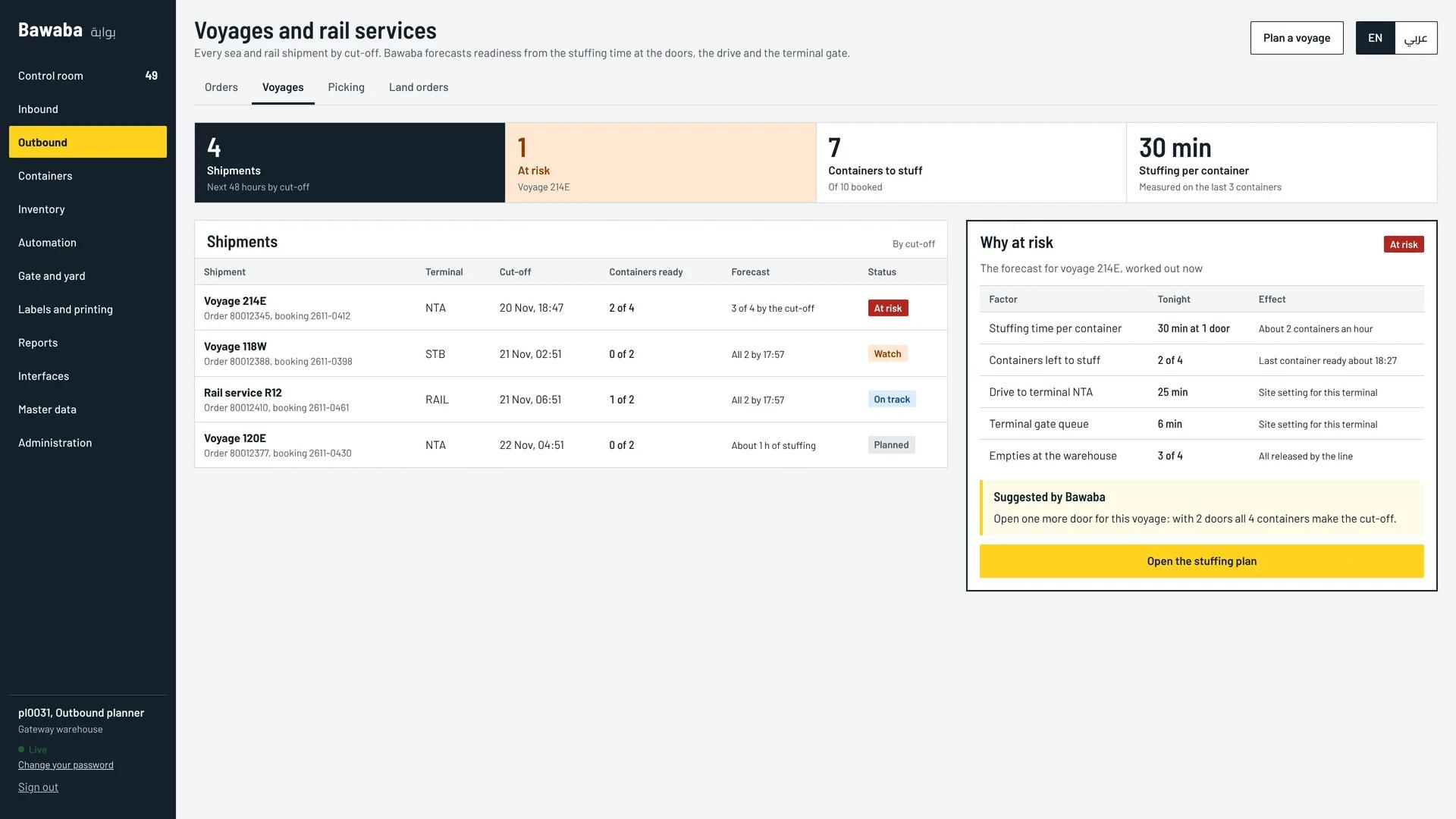
- A cut-off forecast for every voyage and rail service
Authorized vendor to
- Ministry of Finance
- Ministry of Interior
- DGE Abu Dhabi
- Etihad Aviation
- EDGE Group
Delivered for
- Hindustan Unilever
- Nokia
- Linde
- USA Today
- JSL
Procurement-ready
- Emirati national company
- National ICV certificate
- Abu Dhabi Government Procurement Gate
- UAE Ministry of Finance, federal procurement
- Registered ADNOC vendor
The film
Every container runs on a clock
Free time at the terminal, and a cut-off for the ship or the train: how Bawaba runs a warehouse at a port or a dry port, from the gate to the seal.
How it works
From the terminal to the door and back
What Bawaba does with a container at a CFS, an ICD or a dry port.
- 01
Waiting at the terminal
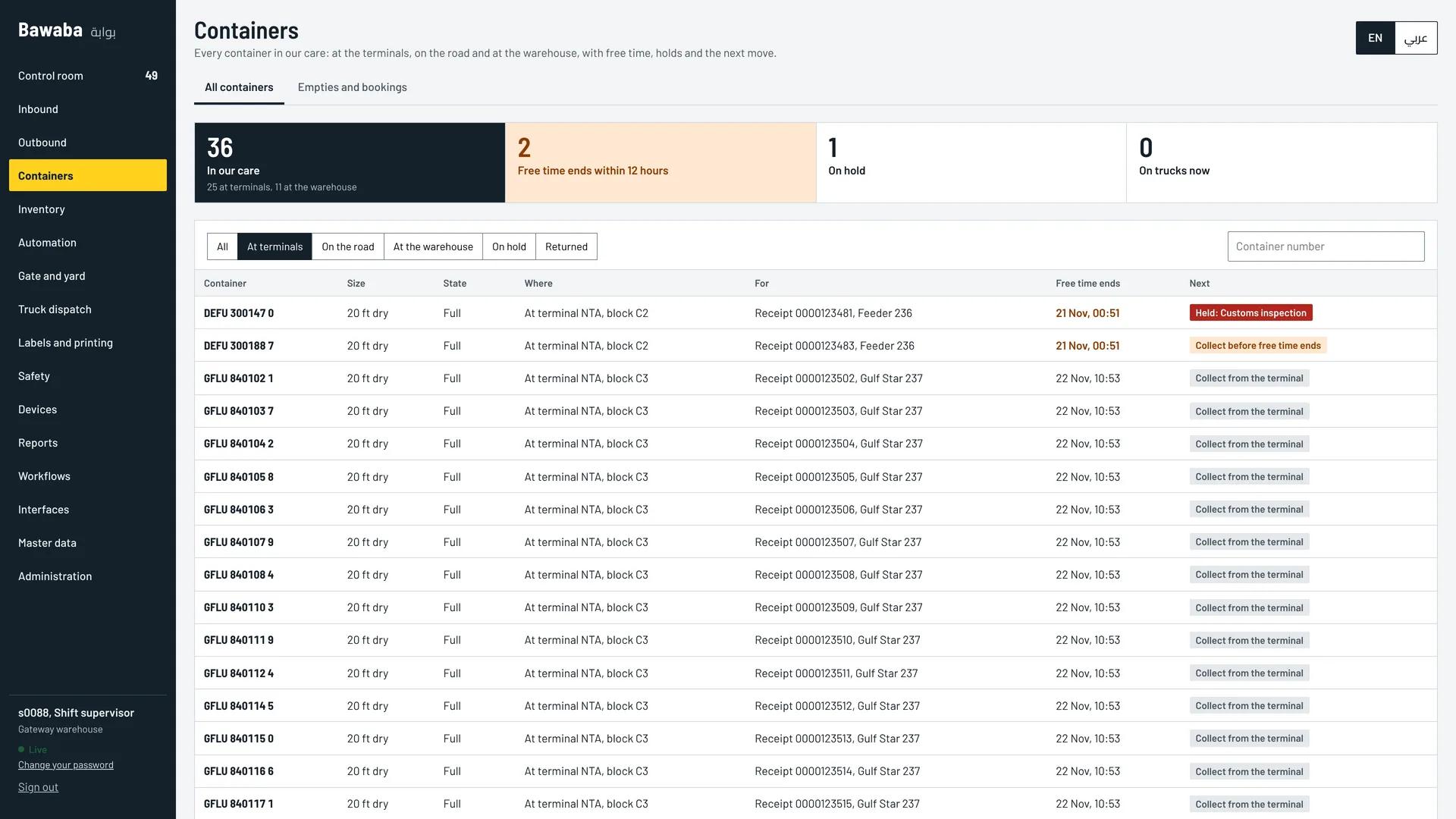
Import containers are listed while they wait at the terminal, with their free time. The shift supervisor is told when free time ends within 12 hours, and a container on a customs hold cannot be checked in until the hold is released.
- 02
At the gate
Gate lane cameras read the number plate and the container code. When the reads match the expected visit, the barrier opens and the sign sends the driver to a door.
- 03
Destuffing at the door
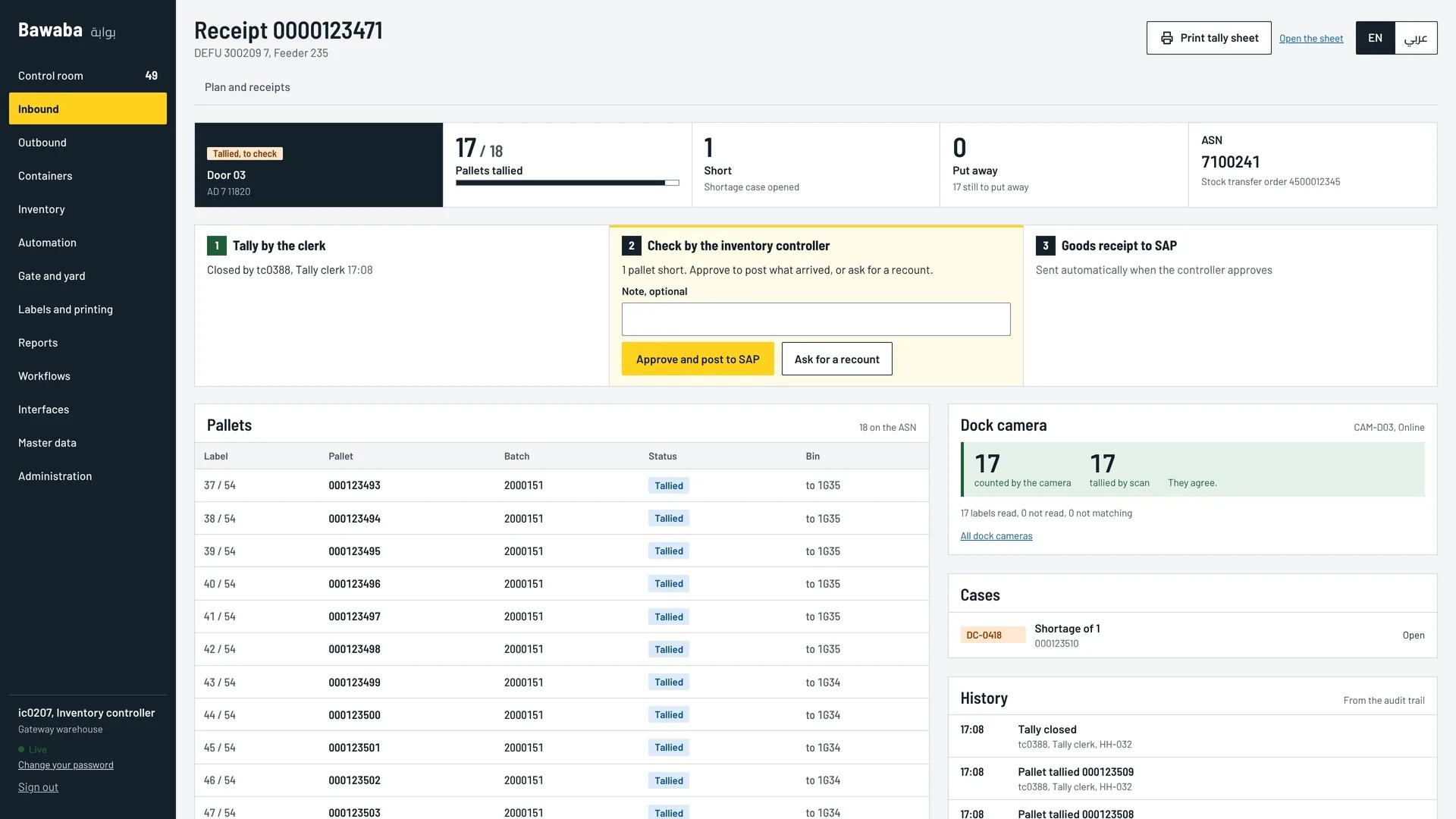
The tally clerk scans every pallet as the container is destuffed (devanned). A pallet not scanned is short, and a shortage case opens for the inventory controller.
- 04
A second check
A second person checks the tally: the person who closed it cannot approve it. Only then does the goods receipt go to SAP.
- 05
Stuffing for the cut-off
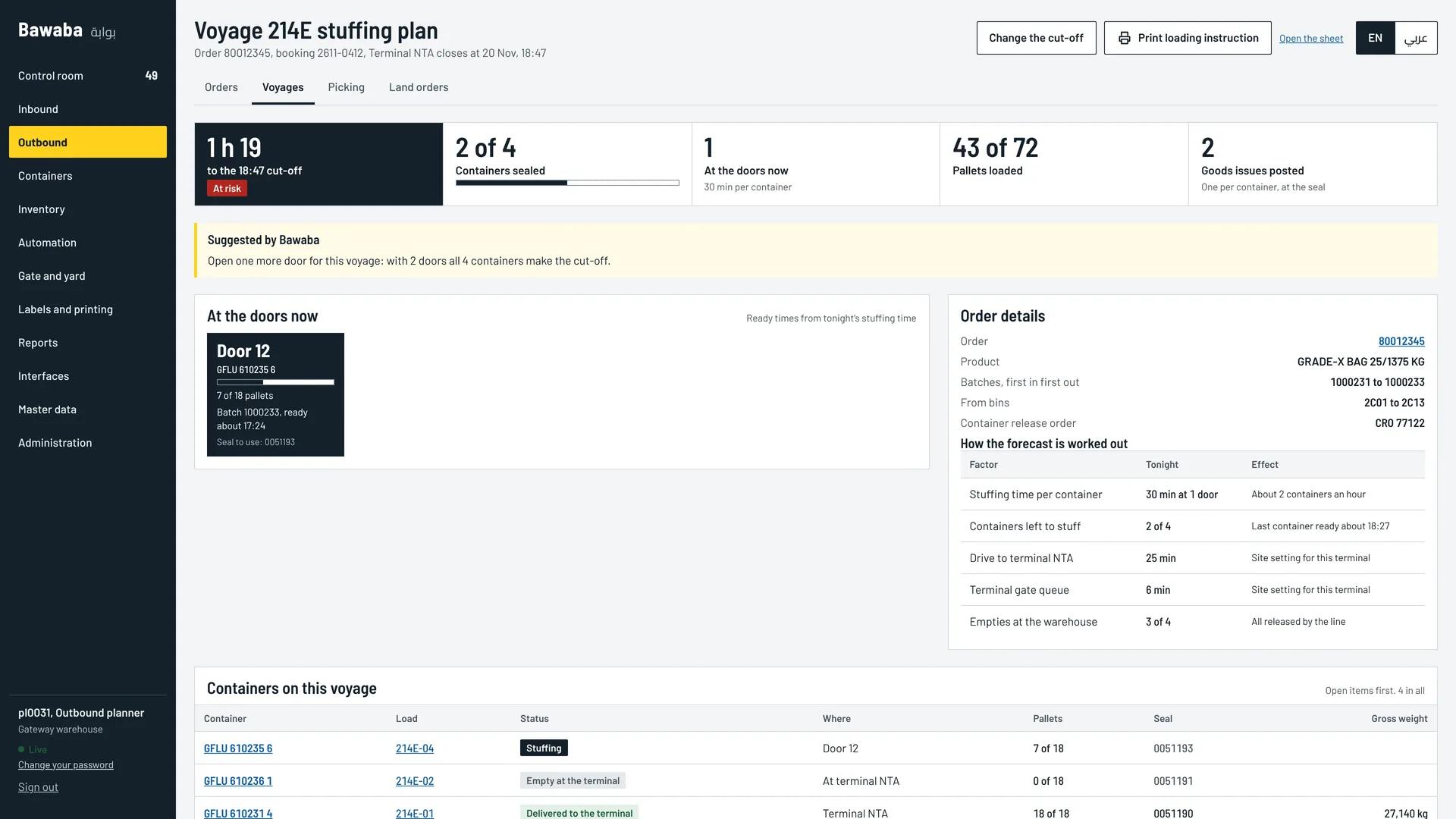
Every voyage and rail service has its stuffing plan: the containers, the pallets for each and the seals. Bawaba forecasts when the last container will reach the terminal.
- 06
Sealed and out
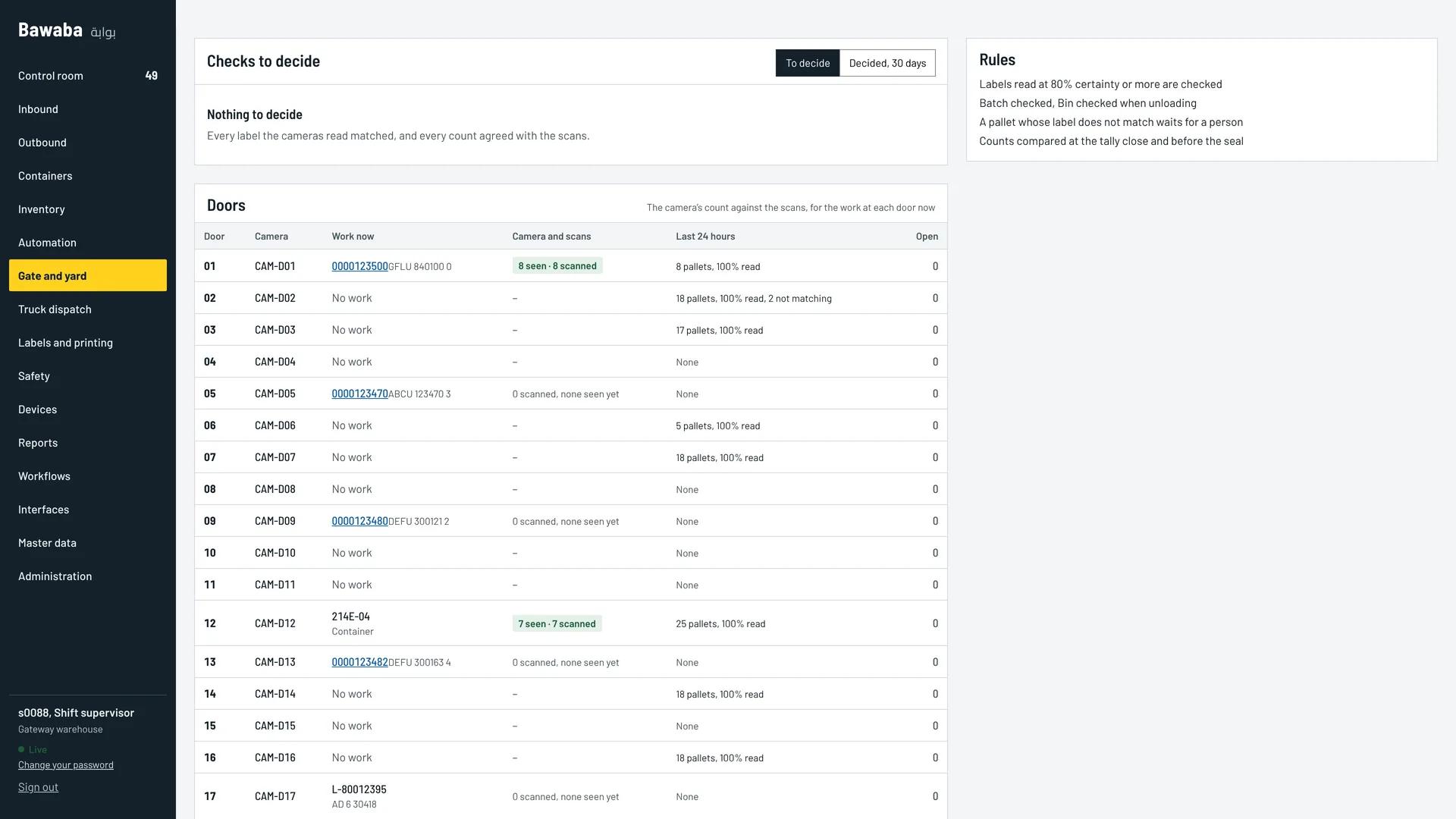
The dock camera's count is compared with the scans before the container is sealed, and the electronic seal is checked again at the gate on the way out.
Product tour
A warehouse at a port, in Bawaba
Screens from Bawaba, shown with sample data for a warehouse served by two sea terminals and a rail freight terminal.
Free time in view
Containers whose free time ends within 12 hours are flagged, so they are collected before charges start.
Two people for every receipt
The person who closed a tally cannot approve it; the goods receipt goes to SAP after the second check.
Cut-offs forecast, not guessed
The forecast uses the stuffing time measured at your doors, the drive and the terminal's gate queue.
Inside Bawaba
Imports, exports, empties and rail
Imports
Free time and holds on every import container
Import containers are listed while they wait at the terminal, with the free time left before storage charges start. The shift supervisor is told when free time ends within 12 hours. A container on hold, for example for a customs inspection, cannot be checked in or leave until the hold is released.
- Free time per container
- The supervisor told before charges start
- Customs holds stop the container at the gate
The gate
Gate lanes that check every truck and container
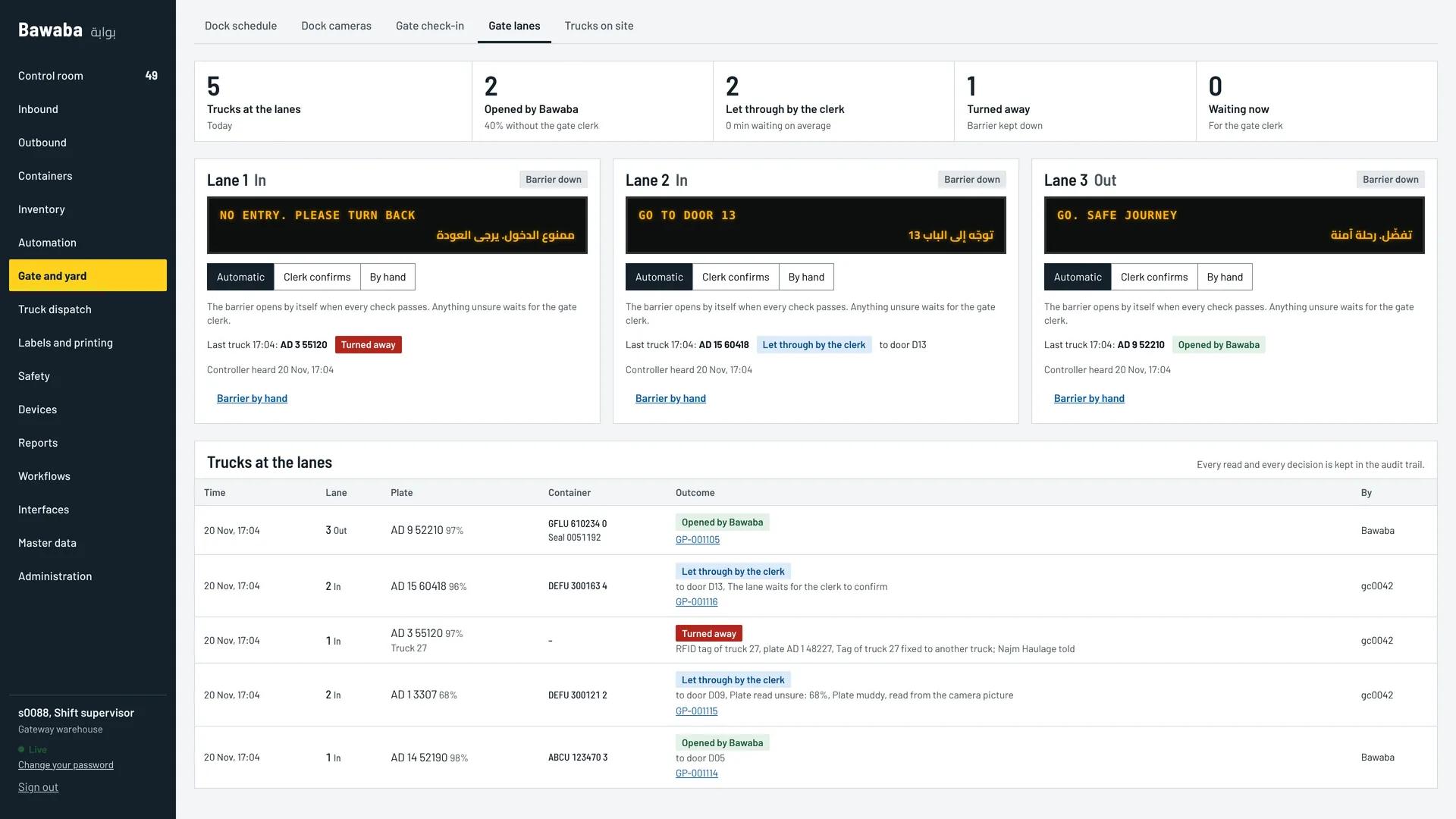
Gate lane cameras read the number plate and the container code, and an RFID reader picks up the truck's tag and any electronic seal. When every check passes, the barrier opens and the sign sends the driver to a door, in Arabic and English. Anything unsure waits for the gate clerk, and every read and decision is kept in the audit trail.
- Plates and container codes read and checked
- Electronic seals checked on the way out
- Anything unsure waits for the gate clerk
Destuffing
A tally at the door, checked by a second person
As a container is destuffed, the tally clerk scans every pallet against the delivery from SAP. Pallets not scanned are short, and a shortage case opens for the inventory controller. The dock camera's count is compared with the scans when the tally closes. The person who closed the tally cannot approve it, and the goods receipt goes to SAP after the second check.
- Every pallet scanned
- Shortages become cases
- The goods receipt to SAP after the check
Exports
A cut-off forecast for every voyage and rail service
Each voyage and rail service has its stuffing plan: the containers, the pallets for each and the seals. Bawaba forecasts when the last container will reach the terminal, from the stuffing time measured at your doors, the drive and the terminal's gate queue. If the cut-off is at risk, it says whether one more door would make it; if not, how many containers will.
- Stuffing plans by voyage and rail service
- Stuffing time measured at the doors
- One more door, or how many make it
Empties and seals
Empties inspected before stuffing, seals checked on the way out
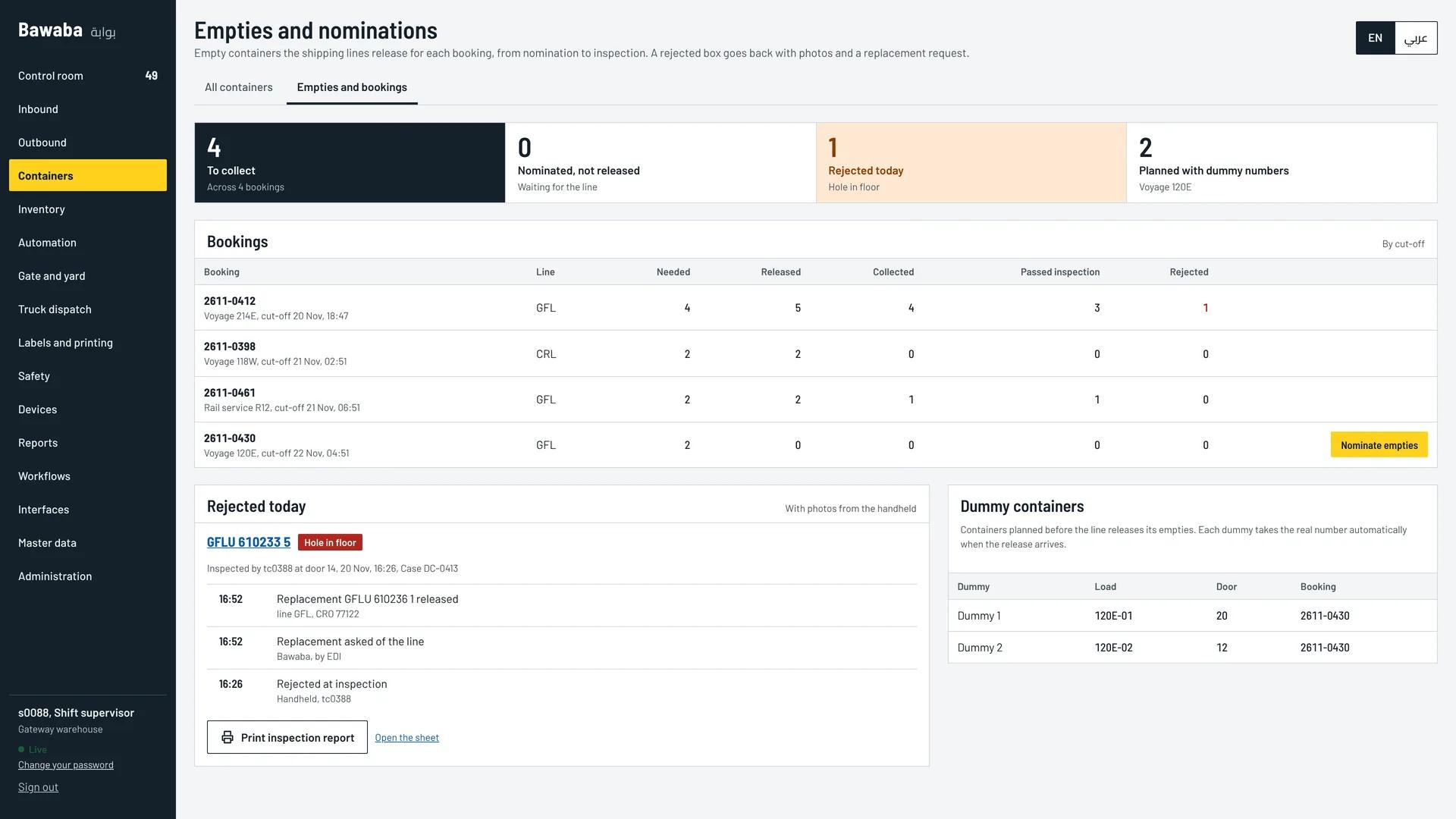
Bawaba keeps each booking with the shipping line, the empties it releases and the result of each inspection at the door. A rejected empty is recorded with its photos and a case, and Bawaba asks the line for a replacement. Before a container is sealed, the dock camera's count must match the scans or a person accepts the difference, and the electronic seal is checked again at the gate on the way out.
- Release orders from the lines
- Rejected empties replaced
- Seals checked at the gate
Shut-out containers
The cargo owner decides
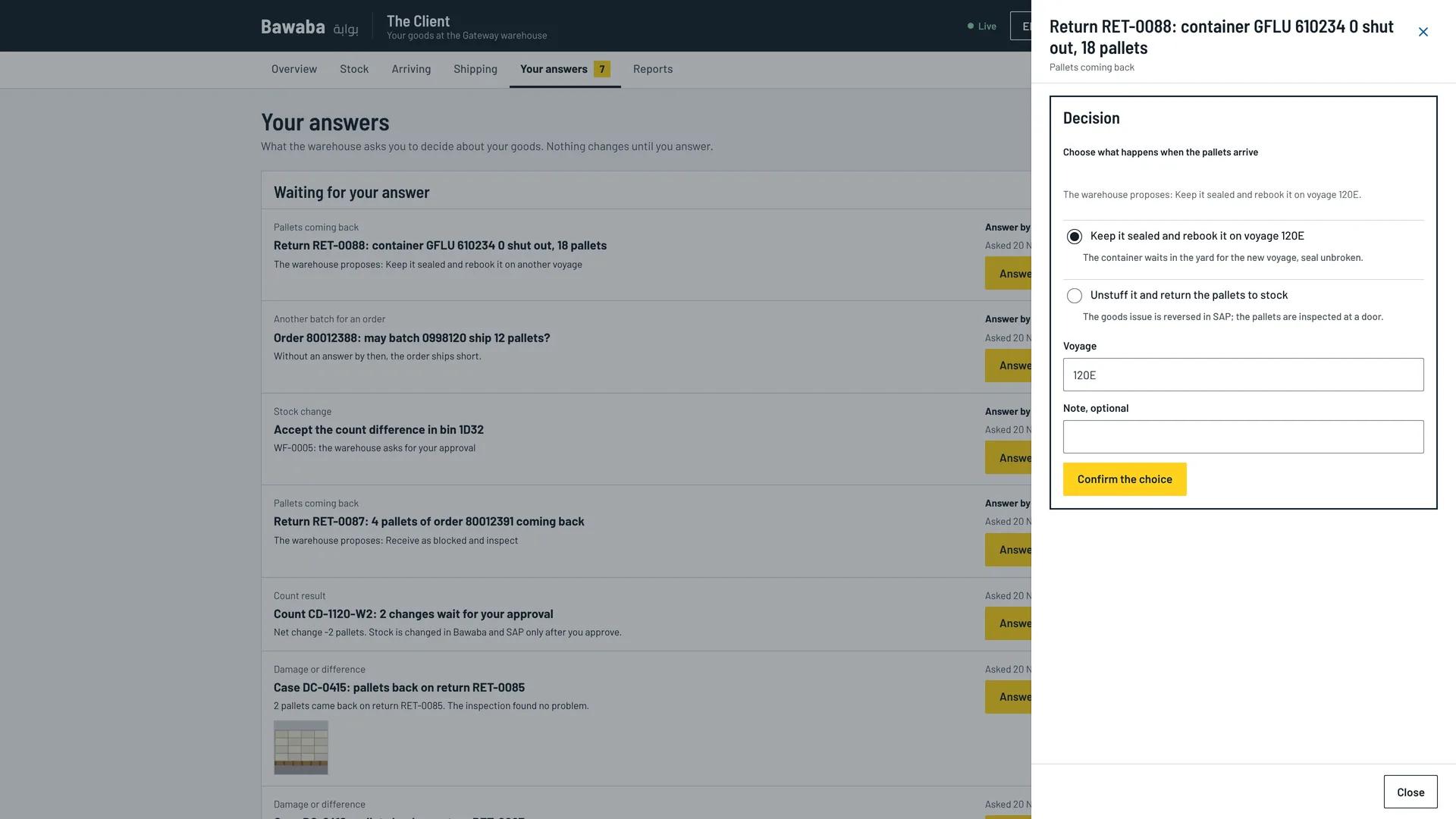
When the terminal shuts a container out of its voyage, the warehouse proposes what to do and the cargo owner decides in their own portal: keep it sealed for the next voyage, or unstuff it and return the pallets to stock, with the goods issue reversed in SAP and the pallets inspected at a door.
- Proposed by the warehouse
- Decided in the cargo owner's portal
- Rebook sealed, or unstuff to stock
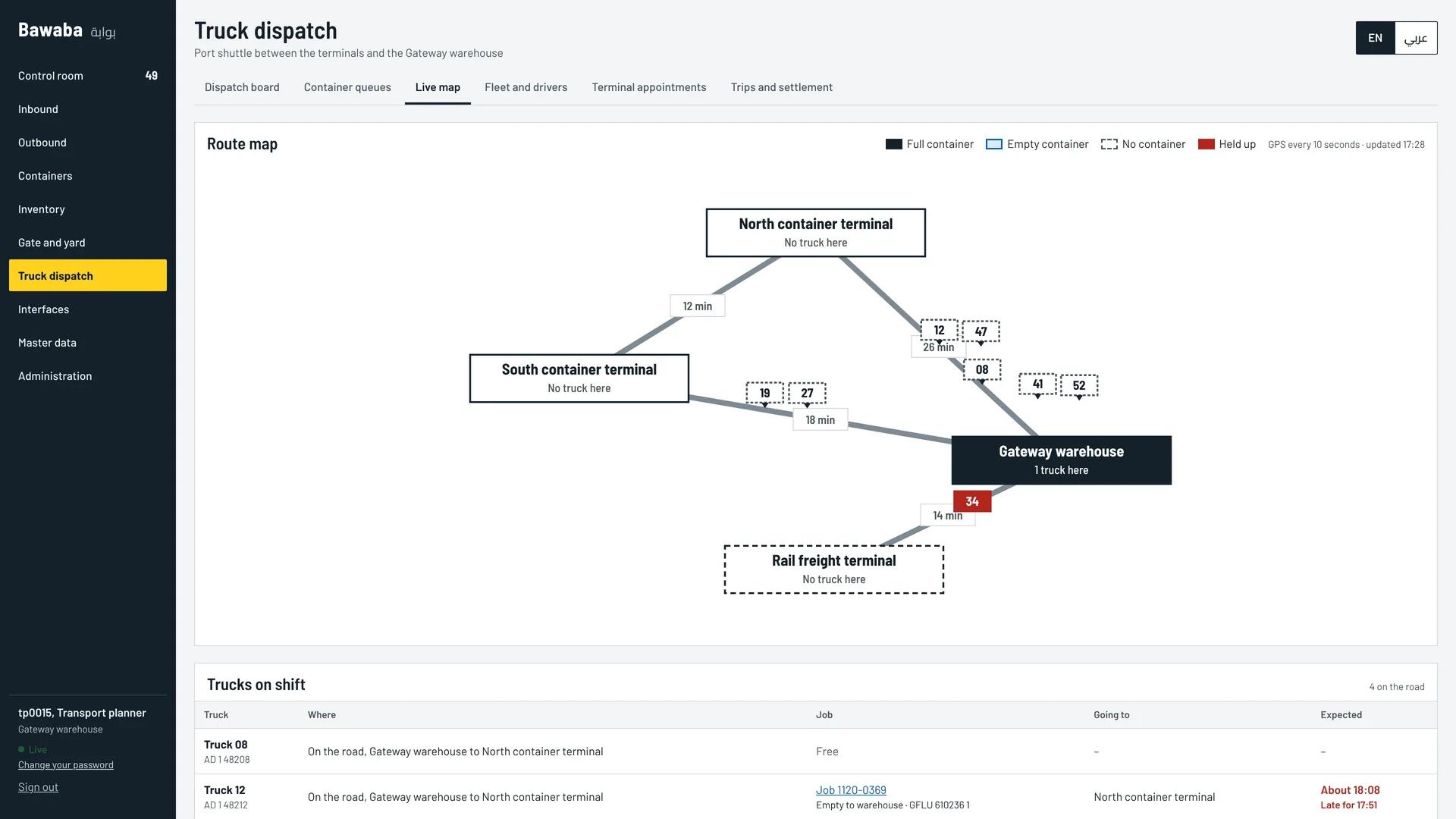
Dry ports and rail
The rail terminal on the same board
For a dry port, the rail freight terminal is a place on Bawaba's truck dispatch and live map, beside the sea terminals and the warehouse. Truck moves to and from it are priced at the rail feed rate, and rail services have their own cut-offs and stuffing plans, like voyages.
- Rail services with cut-offs
- The rail terminal on the live map
- Rail feed rates on the rate card
CFS software or TOS?
Where Bawaba sits next to the terminal
Terminal operating system
Runs the quay, the stacks and the cranes inside a container terminal. Bawaba is not a TOS and does not replace one.
Port community system
Bawaba books terminal slots and reads the gate log through the port community system, and exchanges empties and nominations with the shipping lines.
Bawaba
Runs the warehouse side: containers in your care, doors, stock, trucks and the gate, with deliveries from SAP and goods receipts and issues posted back.
Book a walkthrough
See your CFS or dry port in Bawaba
We show the containers, the tally, the stuffing plan and the gate with sample data shaped like your terminals, doors and rail links.
- A live walkthrough, not slides
- Mapped to your terminals and doors
- In Arabic or English
4.9/5 average rating · 98% client satisfaction · 150+ clients served
FAQ
Container freight station and dry port questions, answered
What is a container freight station (CFS)?
A container freight station is a warehouse near a port where import containers are destuffed and export cargo is stuffed into containers for the ship. Bawaba runs that work: the containers waiting at the terminal with their free time, the tally at the door, the stuffing plan for each voyage and the gate.
What is an inland container depot (ICD) or a dry port?
An inland container depot, dry port or inland port is an inland site linked to a seaport by rail or road, where containers are handled and stored away from the port. Bawaba runs the warehouse side of an ICD or dry port, including rail services with their own cut-offs and truck moves to and from the rail terminal.
Is Bawaba a terminal operating system (TOS)?
No. A TOS runs a container terminal's quay, stacks and cranes. Bawaba runs the warehouse side and works with the terminals through slot bookings and the gate log of the port community system.
Does Bawaba handle customs?
Bawaba shows a customs hold on a container and stops it at the gate until the hold is released. It does not file customs declarations or keep bonded stock accounts; those stay in your customs systems.
How does Bawaba handle a shortage at destuffing?
Pallets the tally clerk did not scan are short when the tally closes, and a shortage case opens for the inventory controller. A second person checks the tally, and the goods receipt goes to SAP with what arrived.
Can Bawaba plan rail services as well as voyages?
Yes. Voyages and rail services are listed by cut-off, each with its stuffing plan and forecast. Truck moves to and from the rail terminal are priced at the rail feed rate.
What happens when a container is shut out at the terminal?
The warehouse proposes what to do, and the cargo owner decides in their portal: keep the container sealed and rebook it on another voyage, or unstuff it and return the pallets to stock, with the goods issue reversed in SAP.
Does Bawaba work with SAP?
Yes. Deliveries and orders come from SAP, and Bawaba posts the goods receipts and goods issues back. Each client's stock is compared with SAP every hour.
Can each cargo owner see their own containers?
Yes. Each client gets a portal with only their own stock, the containers arriving and the orders to ship, and answers the warehouse's questions there.
How is Bawaba licensed?
As an annual on-premise licence installed on your servers, private cloud or an isolated network, or as a monthly or annual cloud subscription that we host in a UAE data center or a cloud region in your country. Both include updates and support.
Every container planned against its free time and cut-off
Book a live Bawaba walkthrough for your CFS, ICD or dry port.
Book a Bawaba walkthrough