Bawaba · Oil and gas supply base software
Supply base management software for oil and gas warehouses, with the stock checked against SAP every hour.
Bawaba runs the warehouse at an oil and gas supply base: drilling materials and chemicals by batch and pallet, blind counts, stock adjustments that need the right approvals, quality holds from SAP, the gate and the trucks. SAP stays the system of record, and Bawaba runs the warehouse beside it.
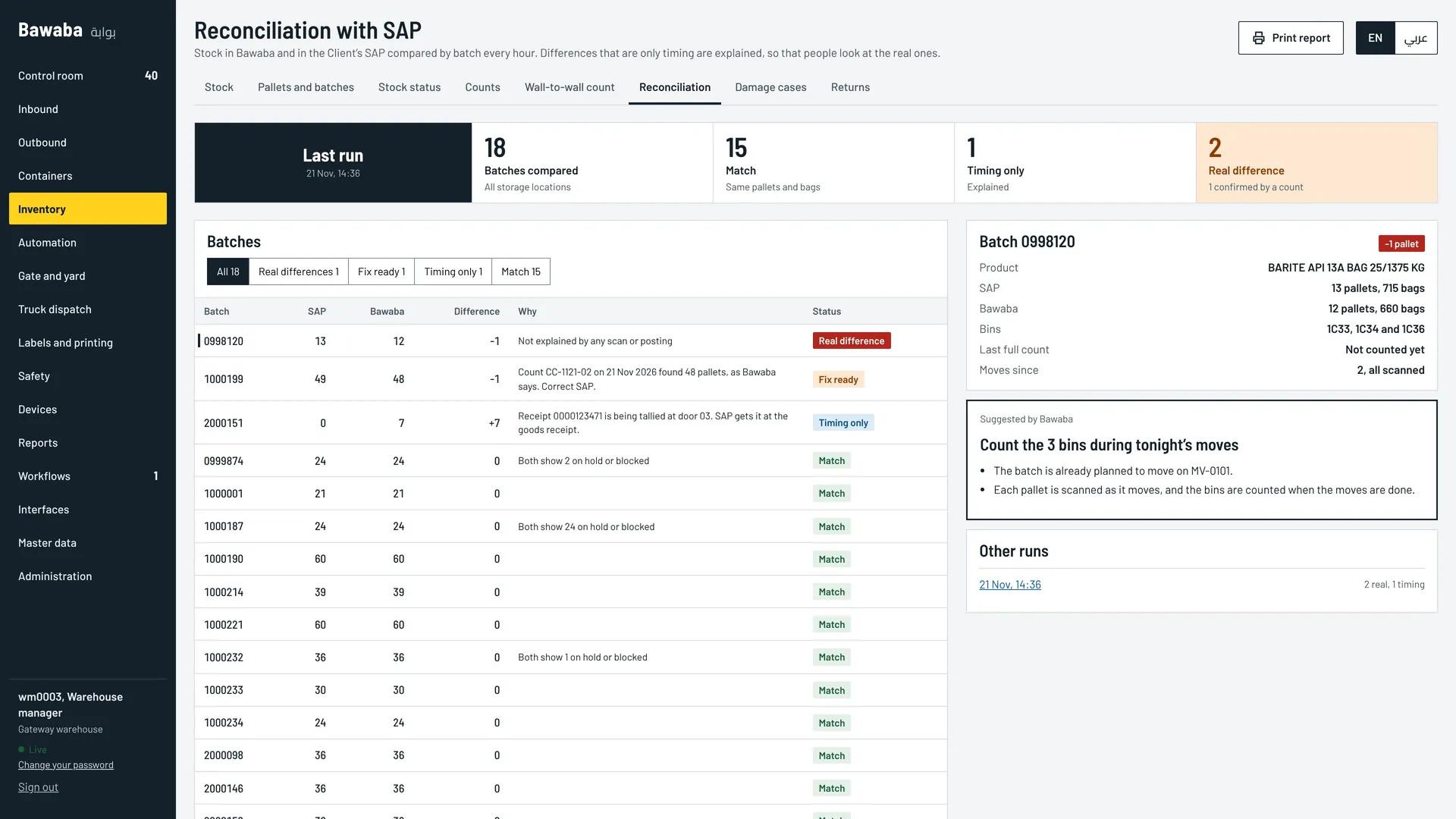
- Stock compared with SAP every hour, batch by batch
- Blind counts, and adjustments approved by the client
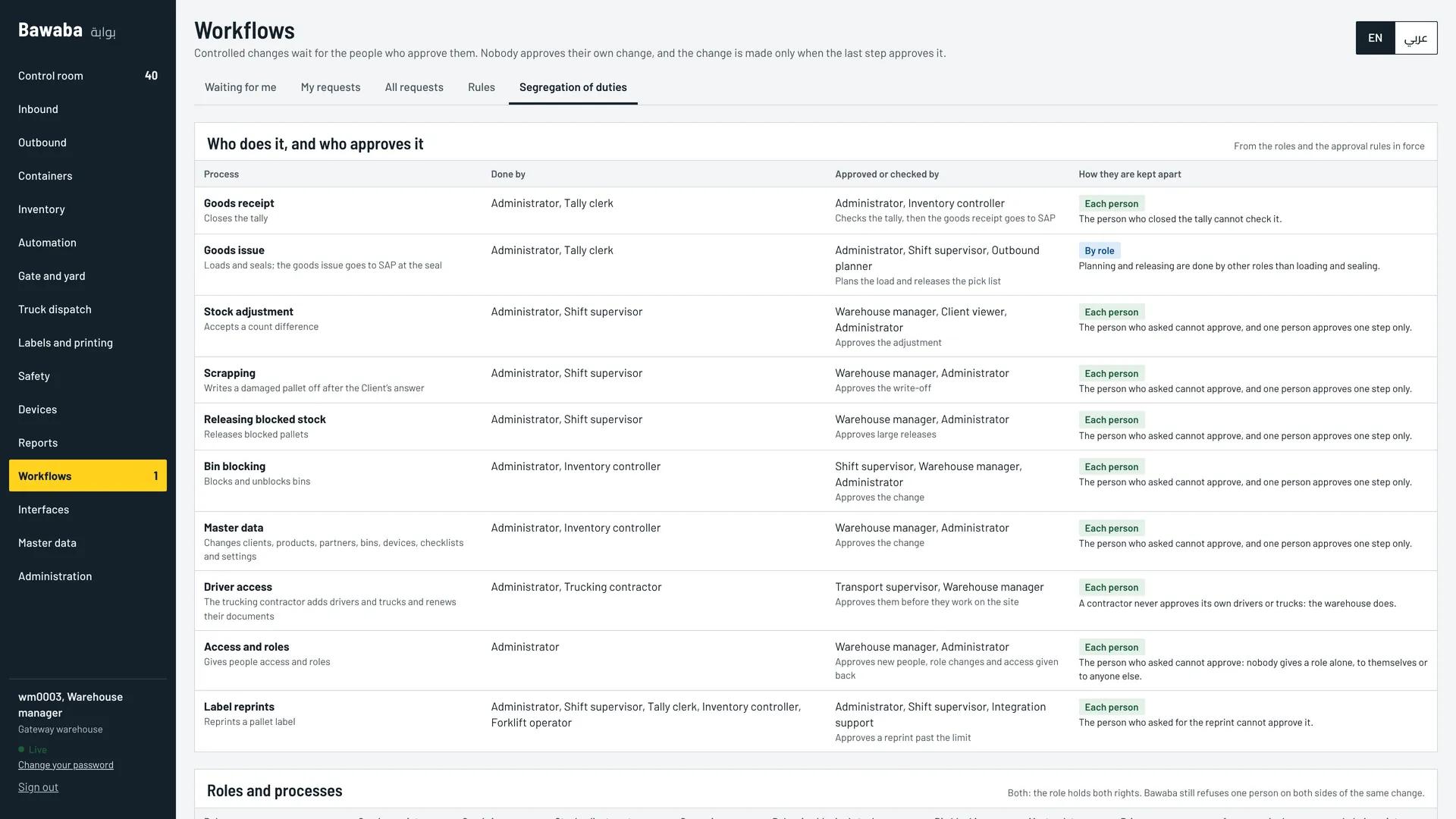
- Nobody approves their own change
Authorized vendor to
- Ministry of Finance
- Ministry of Interior
- DGE Abu Dhabi
- Etihad Aviation
- EDGE Group
Delivered for
- Hindustan Unilever
- Nokia
- Linde
- USA Today
- JSL
Procurement-ready
- Emirati national company
- National ICV certificate
- Abu Dhabi Government Procurement Gate
- UAE Ministry of Finance, federal procurement
- Registered ADNOC vendor
The film
The rigs depend on the warehouse
And on SAP showing what is really in it: how Bawaba runs a warehouse of drilling materials and chemicals at an oil and gas supply base, from the count to the gate.
How it works
From the receipt to the stock SAP can trust
What Bawaba does with drilling materials and chemicals in a supply base warehouse.
- 01
Received against SAP
Deliveries come from SAP. Every pallet is scanned at the door, and a second person checks the tally: the person who closed it cannot approve it. Only then does the goods receipt go to SAP.
- 02
Stored by batch
Each pallet is put away in a bin with its batch, so the stock of every material is known by batch, pallet and bin.
- 03
Compared with SAP every hour
Each client's stock is compared with SAP batch by batch, every hour by default. Differences that are only timing, such as a receipt still being tallied, are explained, so people look at the real ones.
- 04
Counted blind
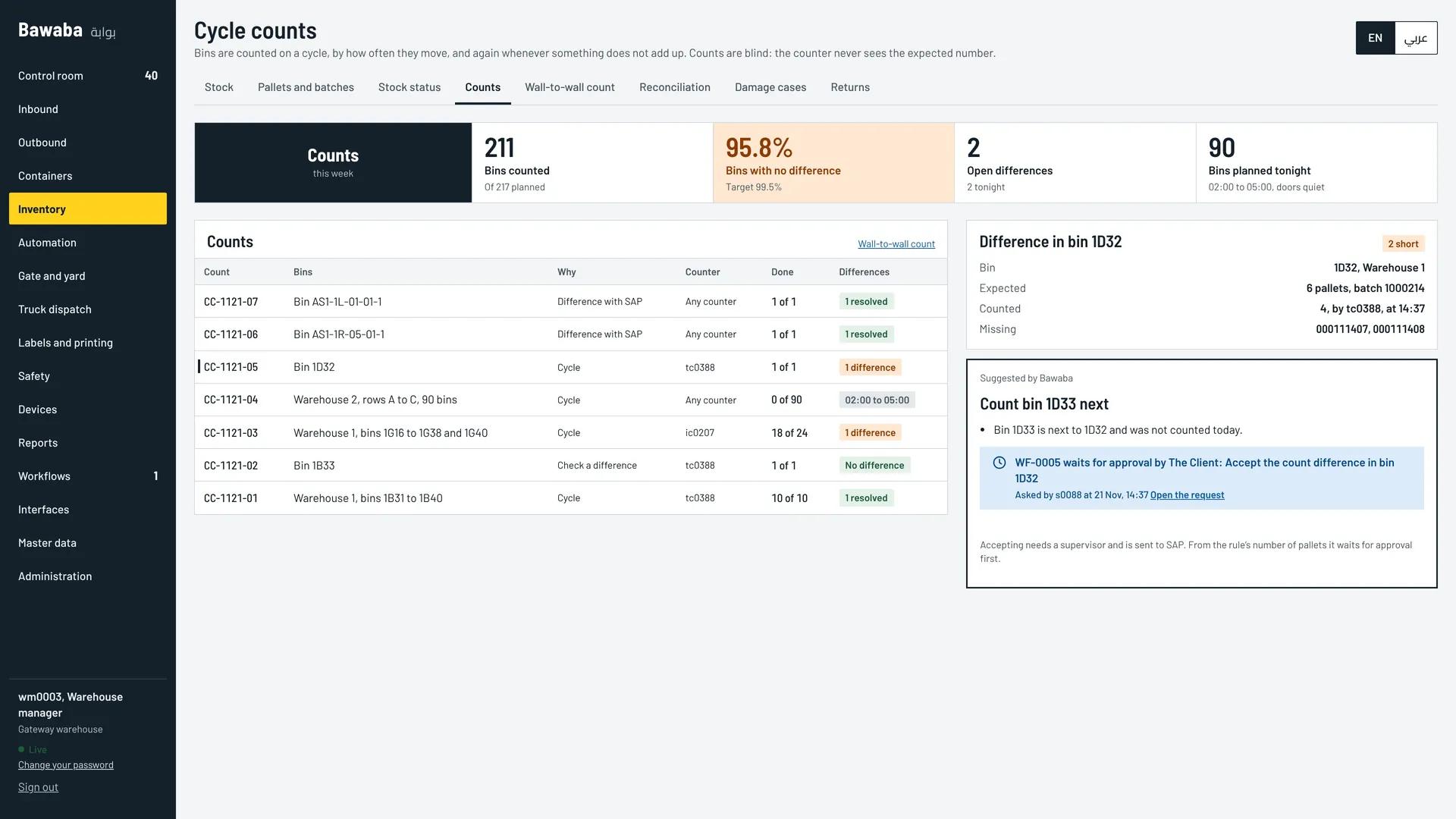
Bins are counted on a cycle and again whenever something does not add up. The counter scans the bin and never sees the number Bawaba expects.
- 05
Approved before it changes
Accepting a count difference needs a supervisor. Above a number of pallets you set, it waits for the warehouse manager and then the client, and nobody approves their own change.
- 06
Held when quality says so
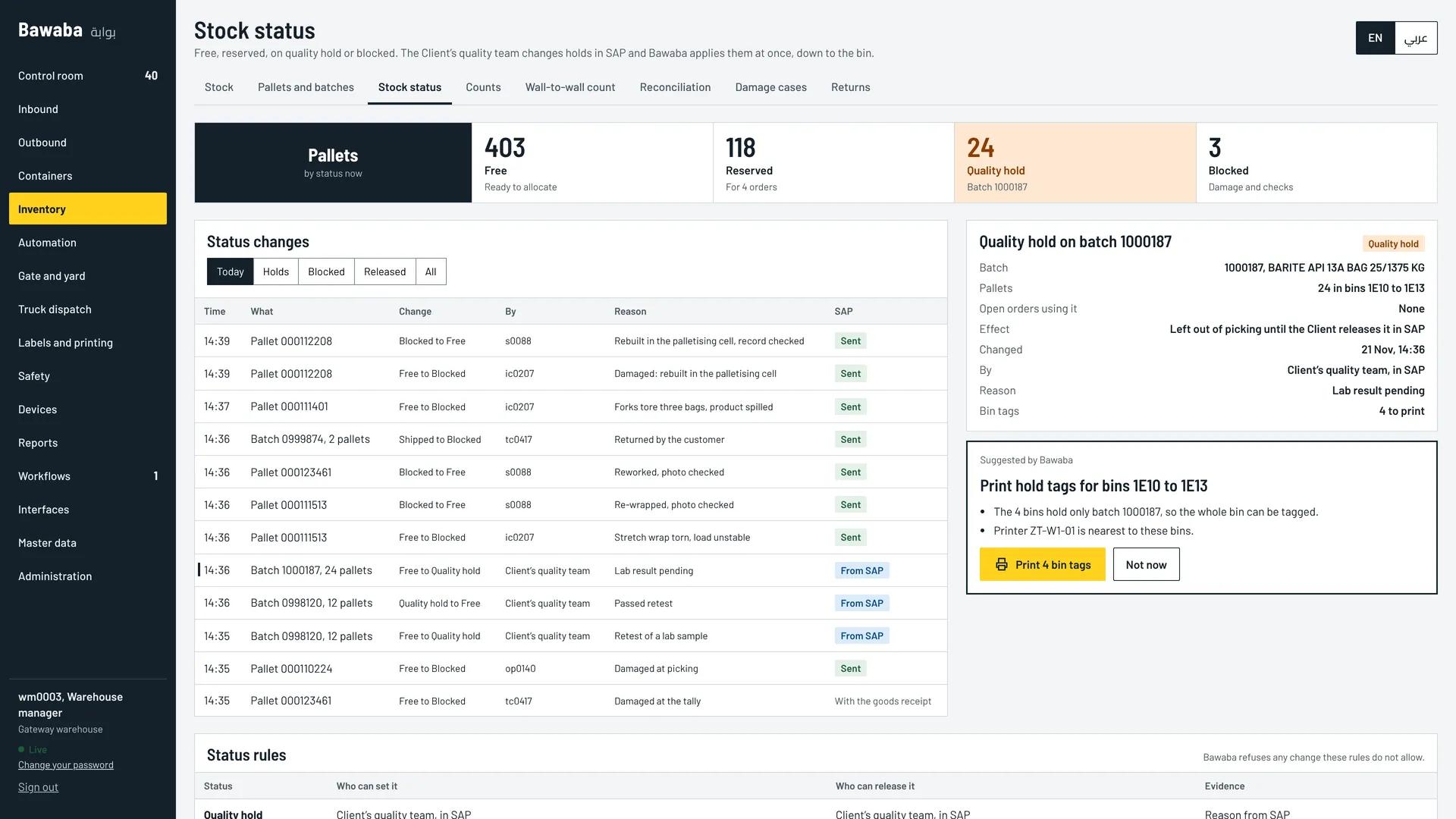
When the client's quality team puts a batch on hold in SAP, Bawaba holds every pallet of it at once and leaves it out of picking until it is released.
Product tour
A supply base warehouse, in Bawaba
Screens from Bawaba, shown with sample data for a warehouse of drilling materials and chemicals: barite, bentonite, calcium carbonate and potassium chloride.
Differences explained
Timing differences are told apart from real ones, so the count goes where it is needed.
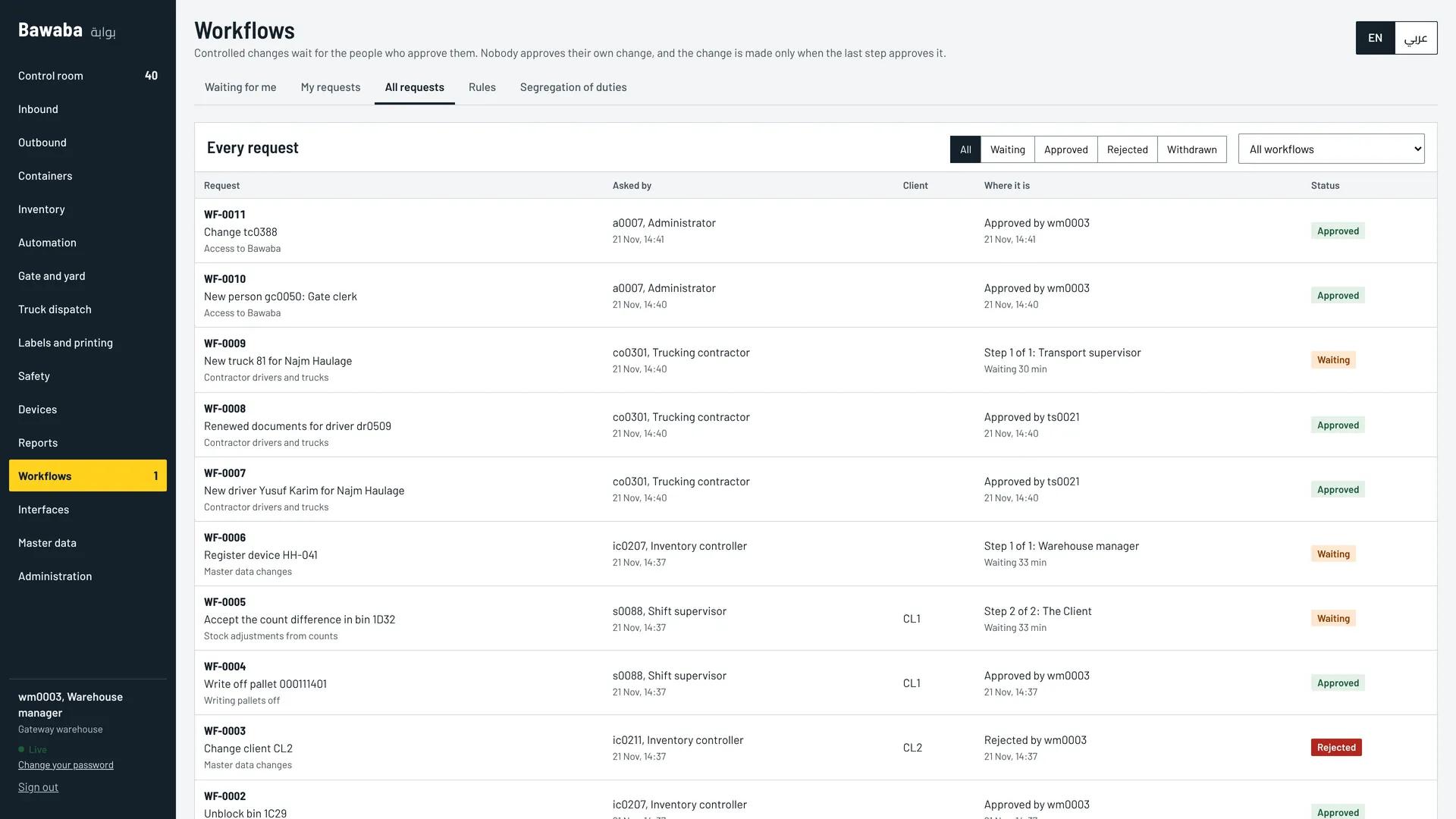
Approvals in order
Warehouse manager first, then the client, for adjustments above the limit you set.
Holds applied at once
A hold set in SAP reaches every pallet of the batch on hand.
Inside Bawaba
Stock, controls, the gate and safety
Stock and SAP
Stock compared with SAP every hour, batch by batch
Bawaba compares each client's stock with SAP batch by batch, every hour by default; you can set anything from 15 minutes to a day. Differences that are only timing, such as a receipt still being tallied at a door or an order being loaded, are explained. Real differences are listed with Bawaba's suggestion, such as counting the bins of the batch during tonight's moves, and a difference confirmed by a count is ready to correct in SAP.
- Batch by batch, client by client
- Timing told apart from real differences
- Fixes confirmed by a count
Counts
Blind counts, and adjustments approved before they post
Bins are counted on a cycle, by how often they move, and again whenever something does not add up; a wall-to-wall count is there when you need one. Counts are blind: the counter scans the bin and never sees the number Bawaba expects. Accepting a difference needs a supervisor and is sent to SAP; above a number of pallets you set, it waits for the warehouse manager and then the client.
- Cycle and wall-to-wall counts
- The expected number never shown
- Adjustments approved before SAP
Segregation of duties
Nobody approves their own change
Bawaba keeps the steps apart person by person. The person who closes a tally cannot check it, the person who asks for a stock adjustment cannot approve it, and one person approves one step only. The rules are on one page, so you can show an auditor who does what.
- Tally closed by one person, checked by another
- Requester never the approver
- One person, one step
Quality holds
On hold in SAP, held in every bin
When the client's quality team puts a batch on hold in SAP, for example while a lab result is pending, Bawaba applies the hold at once to every pallet of the batch on hand and leaves it out of picking. Bawaba suggests printing hold tags for the bins, and the batch is free again when the client releases it in SAP.
- Holds and releases from SAP
- Every pallet of the batch
- Left out of picking
The gate
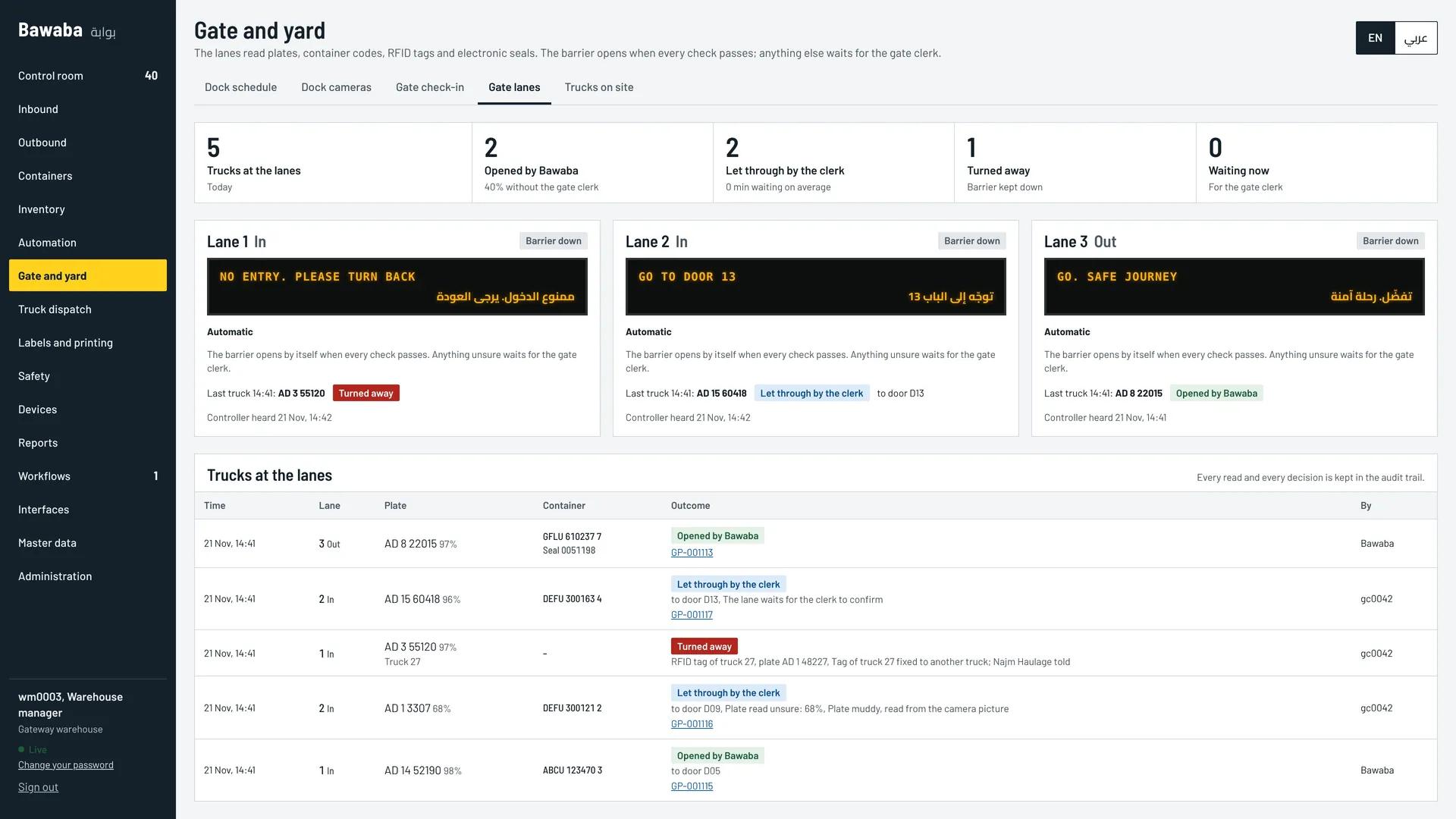
Gate lanes that check every truck
Gate lane cameras read the number plate and the container code, and the RFID tag and any electronic seal are checked. The barrier opens by itself only when every check passes. Anything unsure waits for the gate clerk, who lets the truck through or turns it away, and every read and decision is kept in the audit trail.
- Plates and container codes read
- RFID tags and electronic seals checked
- Anything unsure waits for the gate clerk
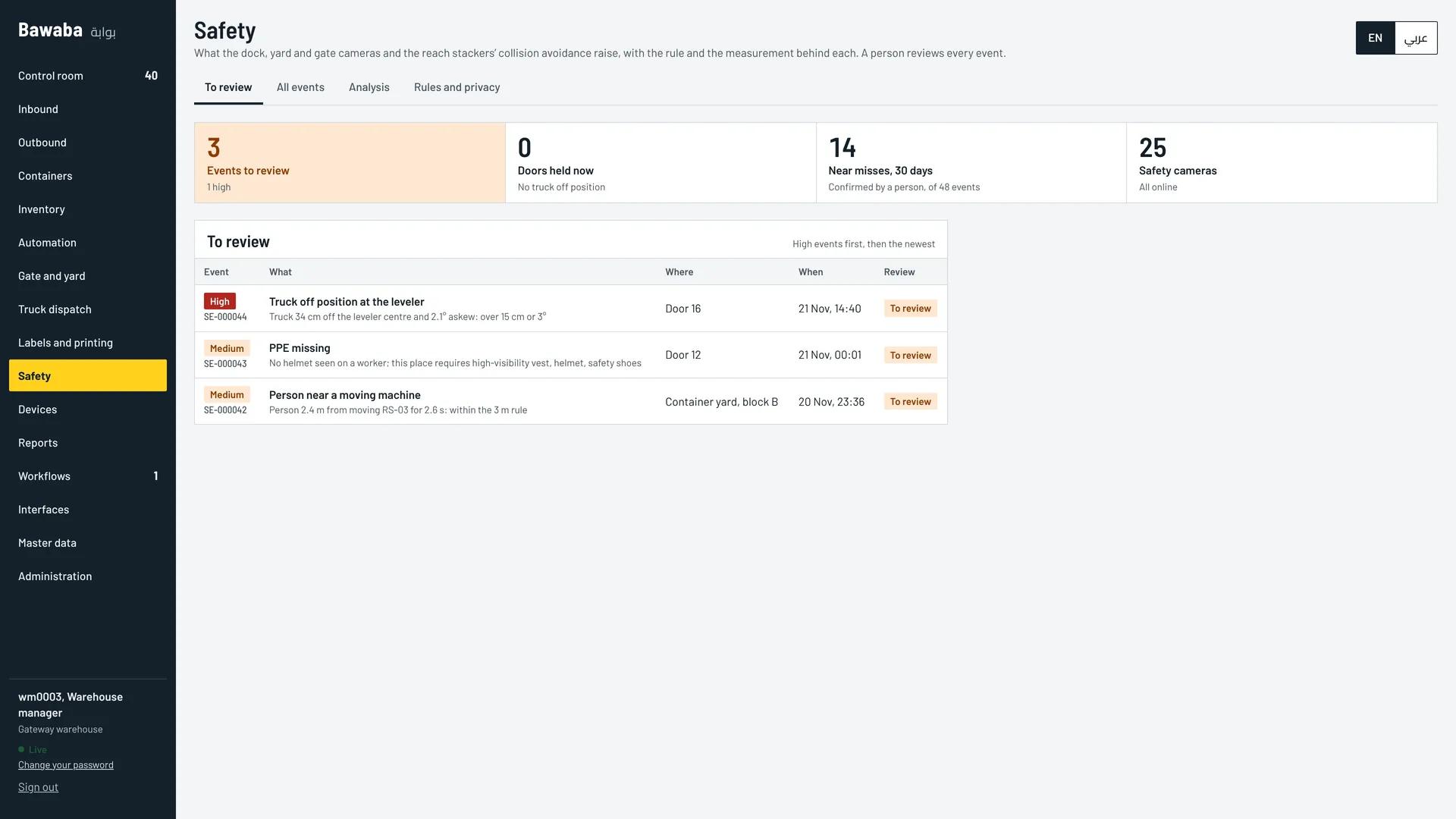
Safety
A person reviews every event
The dock, yard and gate cameras and the collision avoidance on the machines raise safety events: a worker without the protective equipment the place requires, a person too close to a moving machine, a truck off position at a door. Each event comes with its rule and measurement, a truck off position stops work at its door, and a person reviews every event.
- Protective equipment
- People near moving machines
- Trucks off position at the doors
Audit trail
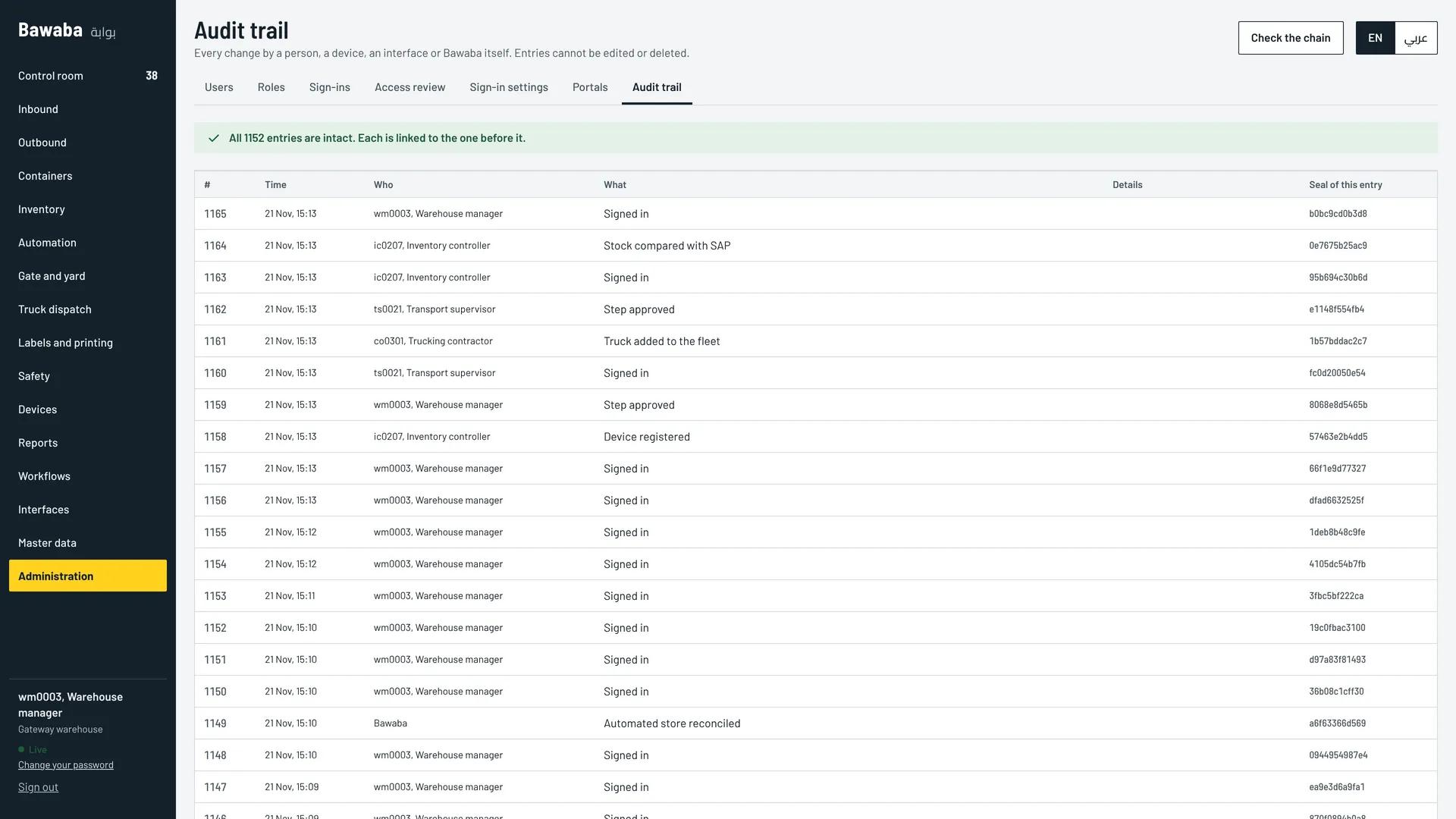
Entries that cannot be edited or deleted
Every change by a person, a device, an interface or Bawaba itself is in the audit trail. Entries cannot be edited or deleted, and each one is sealed to the one before it, so any change to the past would show. Anyone with access can check the chain from the audit trail page.
- People, devices, interfaces and Bawaba
- Each entry sealed to the one before
- The chain checked on demand
Bawaba and SAP
Beside SAP, not in place of it
SAP
Stays the system of record: materials, orders and postings, and the quality team's holds and releases.
Between them
Deliveries, orders and quality holds come from SAP. Goods receipts, goods issues and stock changes go back to SAP, kept and resent in order.
Bawaba
Runs the warehouse beside SAP: the bins, the people, the counts, the gate and the trucks, with each client's stock compared with SAP every hour.
Book a walkthrough
See your supply base warehouse in Bawaba
We show the stock check against SAP, the counts, the approvals, the quality holds and the gate with sample data shaped like your materials, bins and clients.
- A live walkthrough, not slides
- Mapped to your materials and bins
- In Arabic or English
4.9/5 average rating · 98% client satisfaction · 150+ clients served
FAQ
Oil and gas supply base warehouse questions, answered
What does Bawaba do at an oil and gas supply base?
Bawaba runs the supply base's warehouse: drilling materials and chemicals received against SAP, stored by batch and pallet, counted blind, compared with SAP every hour and picked for the trucks, with the gate lanes, safety events and the audit trail on the same system.
Does Bawaba plan supply vessel loads?
No. Bawaba runs the warehouse, the gate and the trucks. Loading plans for supply vessels stay in your marine and logistics systems.
How does Bawaba keep the stock in line with SAP?
Bawaba compares each client's stock with SAP batch by batch, every hour by default, from 15 minutes to a day as you set it. Differences that are only timing are explained, real differences are counted, and a difference confirmed by a count is corrected in SAP.
Are counts blind?
Yes. The counter scans the bin and never sees the number Bawaba expects. A supervisor accepts a difference, and above a number of pallets you set it waits for the warehouse manager and then the client before it reaches SAP.
Who can approve a stock adjustment?
The approvers you set for the rule, by default the warehouse manager and then the client. The person who asked for the adjustment cannot approve it, and one person approves one step only.
How are quality holds handled?
The client's quality team puts a batch on hold or releases it in SAP. Bawaba applies the hold at once to every pallet of the batch on hand and leaves it out of picking until the release.
Does Bawaba work with SAP?
Yes. Deliveries, orders and quality holds come from SAP, and Bawaba posts the goods receipts, goods issues and stock changes back. Messages are kept and resent in order, so nothing is lost when a system does not answer.
Can each client see only their own stock?
Yes. Each client gets a portal with only their own stock, the deliveries arriving and the orders to ship, and answers there what the warehouse asks them to decide, such as a stock adjustment. Nothing changes until they answer.
Does Bawaba work in Arabic?
Yes. Every screen works in Arabic and English, each person chooses their language, and the Arabic screens read right to left.
How is Bawaba licensed?
As an annual on-premise licence installed on your servers, private cloud or an isolated network, or as a monthly or annual cloud subscription that we host in a UAE data center or a cloud region in your country. Both include updates and support.
Supply base stock you can show an auditor
Book a live Bawaba walkthrough for your oil and gas supply base warehouse.
Book a Bawaba walkthrough