Free checklist · Application security
Secure code review checklist mapped to the OWASP Top 10:2025.
Download a secure code review checklist in Excel: 63 checks in 12 areas, each mapped to the OWASP Top 10:2025 and OWASP ASVS 5.0, with a findings log and a summary that updates itself. In English and Arabic, and free.
- 63 checks in 12 areas
- OWASP Top 10:2025 and ASVS 5.0
- English and Arabic
Free checklist
Secure code review checklist in Excel
Mark each check Pass, Fail, N/A or Not checked, log failures on the Findings sheet, and the Summary sheet counts them by area, severity and OWASP category.
Authorized vendor to
- Ministry of Finance
- Ministry of Interior
- DGE Abu Dhabi
- Etihad Aviation
- EDGE Group
Delivered for
- Hindustan Unilever
- Nokia
- Linde
- USA Today
- JSL
Procurement-ready
- Emirati national company
- National ICV certificate
- Abu Dhabi Government Procurement Gate
- UAE Ministry of Finance, federal procurement
- Registered ADNOC vendor
What’s inside
Mark each check, log each finding
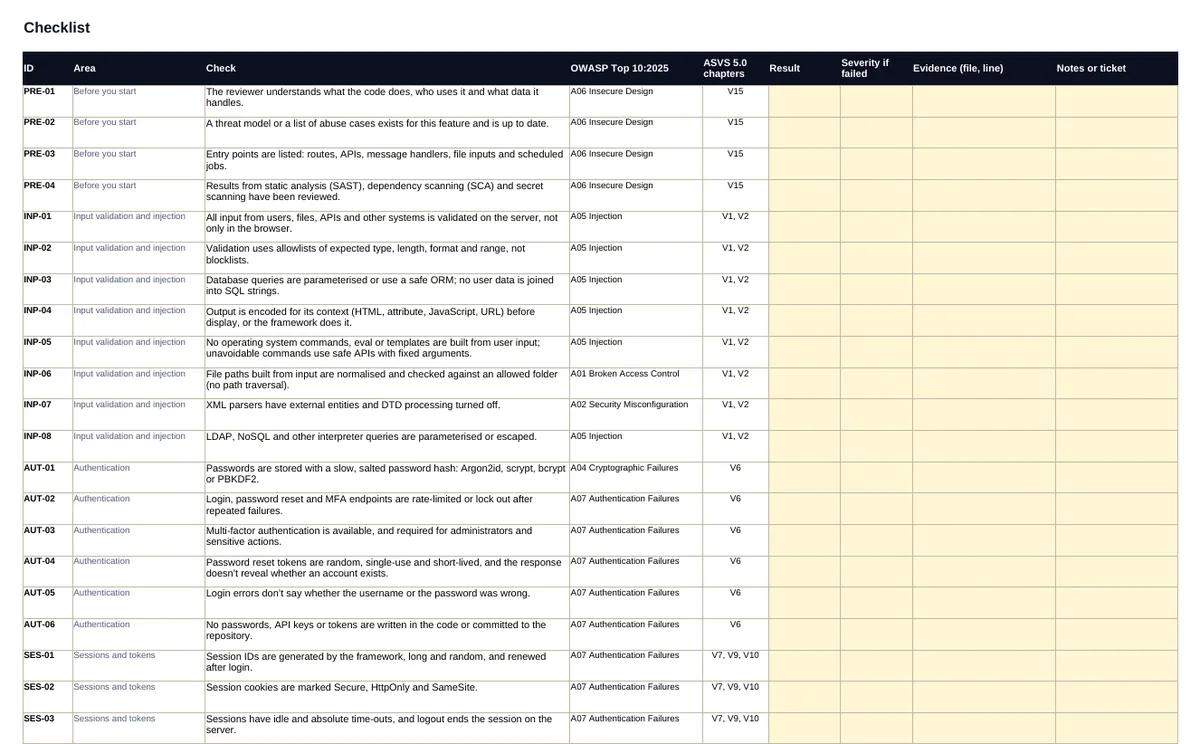
Twelve areas, one place to record them
The checks cover what scanners often miss, such as access control and business logic, as well as the basics. Each one names its OWASP Top 10:2025 category and the ASVS 5.0 chapters to read for the full requirements.
- Preparation, input and injection, authentication, sessions and tokens, access control
- Cryptography and data protection, errors, logging, dependencies and supply chain
- Configuration, business logic, APIs and files
- A findings log with severity, location, fix, owner and status
OWASP Top 10:2025
The OWASP Top 10:2025, and what to check
Released by OWASP in November 2025. Two categories are new, A03 and A10, and server-side request forgery is now part of A01.
A01 Broken Access Control
Every request is authorised on the server, users reach only their own records, and requests to user-supplied URLs are restricted.
A02 Security Misconfiguration
Up from fifth place in 2021. Debug modes off, defaults removed, security headers set and cloud storage private.
A03 Software Supply Chain Failures
New, and wider than 2021’s vulnerable components: trusted, pinned dependencies, dependency scans and a protected build pipeline.
A04 Cryptographic Failures
TLS everywhere, current algorithms, keys in a vault and passwords stored with a slow, salted hash.
A05 Injection
Parameterised queries, output encoded for its context, and no commands built from user input.
A06 Insecure Design
A threat model for new features, and business rules enforced on the server.
A07 Authentication Failures
Multi-factor authentication for administrators, rate-limited logins, safe password resets and well-protected sessions.
A08 Software or Data Integrity Failures
Signatures and checksums checked on code and updates, and no untrusted data deserialised without checks.
A09 Security Logging & Alerting Failures
Security events logged without secrets, and alerts that reach someone who acts on them.
A10 Mishandling of Exceptional Conditions
New. Errors handled, failing closed, resources released and internal details kept out of error messages.
How to use it
How to run a secure code review
- 01
Prepare
Understand what the code does, its users and its data, and read the threat model and earlier findings.
- 02
Run the tools first
Static analysis, dependency and secret scans find common issues. Review their results before you read the code.
- 03
Follow the data
Start at each entry point and trace input through validation, business logic and output.
- 04
Check the controls
Authentication, access control, cryptography, error handling and configuration, using the checklist.
- 05
Log, fix and re-check
Record each issue with its file and line, fix it, and verify the fix before you approve the change.
Two kinds of review
Baseline and change reviews
Baseline review
For a new application or a first review: the whole codebase, its architecture, its dependencies and its configuration.
Change (diff) review
For each pull request: the changed code and the code it affects, starting with the riskiest changes.
Next steps
Check every build, not just the ones you review
Sources
Sources
Checked on 15 November 2026. The checks are written for this checklist; use ASVS for the full list of requirements.
Book a demo
See Falaj gate a real pipeline
We connect a sample application, run static, dependency and secrets scans, block a release with a policy and walk through the fix, in English or Arabic.
- A live demo, not slides
- Mapped to your pipelines and tools
- Under NDA if you need one
4.9/5 average rating · 98% client satisfaction · 150+ clients served
FAQ
Secure code review, answered
What is a secure code review?
A review of source code to find security flaws before release, by people working from a checklist with help from tools such as static analysis. It catches issues tools miss, such as broken access control and flawed business logic.
What should be checked in a code review for security?
Input validation and injection, authentication and sessions, access control, cryptography and data protection, error handling, logging, dependencies, configuration, business logic and APIs. The checklist covers each area.
What is the OWASP Top 10:2025?
OWASP’s list of the ten most critical web application security risks, released in November 2025. Broken Access Control stays first; Software Supply Chain Failures and Mishandling of Exceptional Conditions are new.
What is OWASP ASVS?
The Application Security Verification Standard: OWASP’s detailed security requirements for web applications and APIs. Version 5.0.0, released in May 2025, has 17 chapters and three levels.
What are some secure code review tools?
Static analysis (SAST) for your code, software composition analysis (SCA) for dependencies, secret scanning, and dynamic testing (DAST) of the running application. Falaj combines these in your pipeline.
Is the checklist free?
Yes. Download it, change it and use it in your team, with no sign-up.