Hawiya · Banks, NBFCs and CERT-In
Access controls for the RBI cyber security framework and CERT-In, hosted in India or on your servers.
On 31 July 2026 the RBI moved its cyber security and IT governance instructions into directions for each type of regulated entity, with immediate effect. For commercial banks they ask for centralised authentication and authorisation, multi-factor authentication for privileged users of critical systems and for teleworkers, limits on invalid logon attempts, dormant accounts deactivated and audit trails. Hawiya is designed to apply those controls once, for every app your people sign in to, with its records kept in India as CERT-In’s directions require.
- One sign-in for every app
- MFA for privileged users and remote access
- Records kept in India
Authorized vendor to
- Ministry of Finance
- Ministry of Interior
- DGE Abu Dhabi
- Etihad Aviation
- EDGE Group
Delivered for
- Hindustan Unilever
- Nokia
- Linde
- USA Today
- JSL
Procurement-ready
- Emirati national company
- National ICV certificate
- Abu Dhabi Government Procurement Gate
- UAE Ministry of Finance, federal procurement
- Registered ADNOC vendor
RBI guidelines
The RBI cyber security framework, now in the 2026 directions
The Cybersecurity, Technology: Risk, Resilience and Assurance Framework Directions, 2026 were issued on 31 July 2026 for each type of regulated entity, as the RBI repealed 628 older circulars.
Commercial banks
Paragraph 109 asks for centralised authentication and authorisation for applications, operating systems, databases and network and security devices, with a strong password policy, least privilege and separation of duties.
MFA where it matters
Paragraph 110 asks for two-factor or multi-factor authentication based on risk, and makes multi-factor authentication mandatory for privileged users of critical information systems and critical activities. Paragraph 114 asks for it on teleworkers’ access to critical systems.
NBFCs
For NBFCs in the middle layer and above, paragraph 115 asks for two-factor or multi-factor authentication for privileged users of critical systems, and paragraph 116 for multi-factor authentication on teleworkers’ access to critical systems.
Paragraph by paragraph
RBI and CERT-In rules, and how Hawiya is designed to help
For commercial banks, from the RBI’s 2026 directions, and for everyone covered by CERT-In’s directions. Hawiya covers sign-in to the apps connected to it.
| Rule | The rule asks | Hawiya |
|---|---|---|
| RBI, paragraph 109 | Centralised authentication and authorisation, a strong password policy, least privilege and separation of duties. | One sign-in for every connected app, password rules, and access to each app by group or role. |
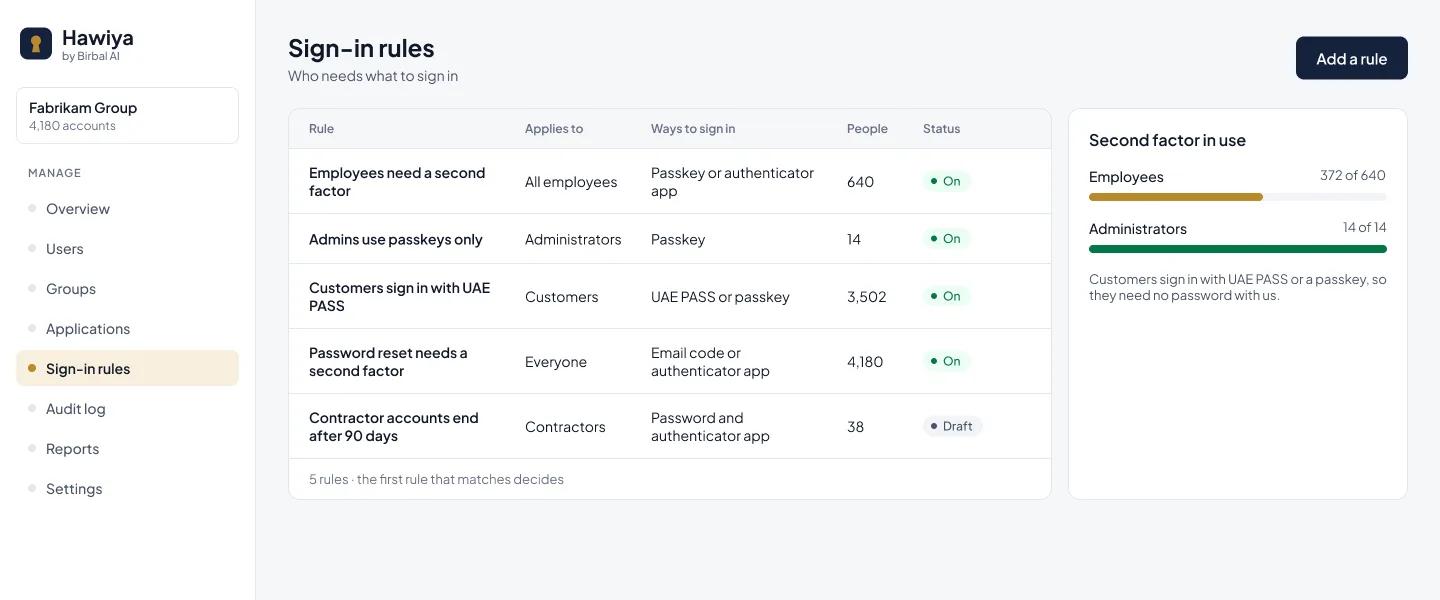
| RBI, paragraph 110 | Multi-factor authentication for privileged users of critical systems and critical activities. | Passkeys only for administrators, and a second factor for any group you choose. |
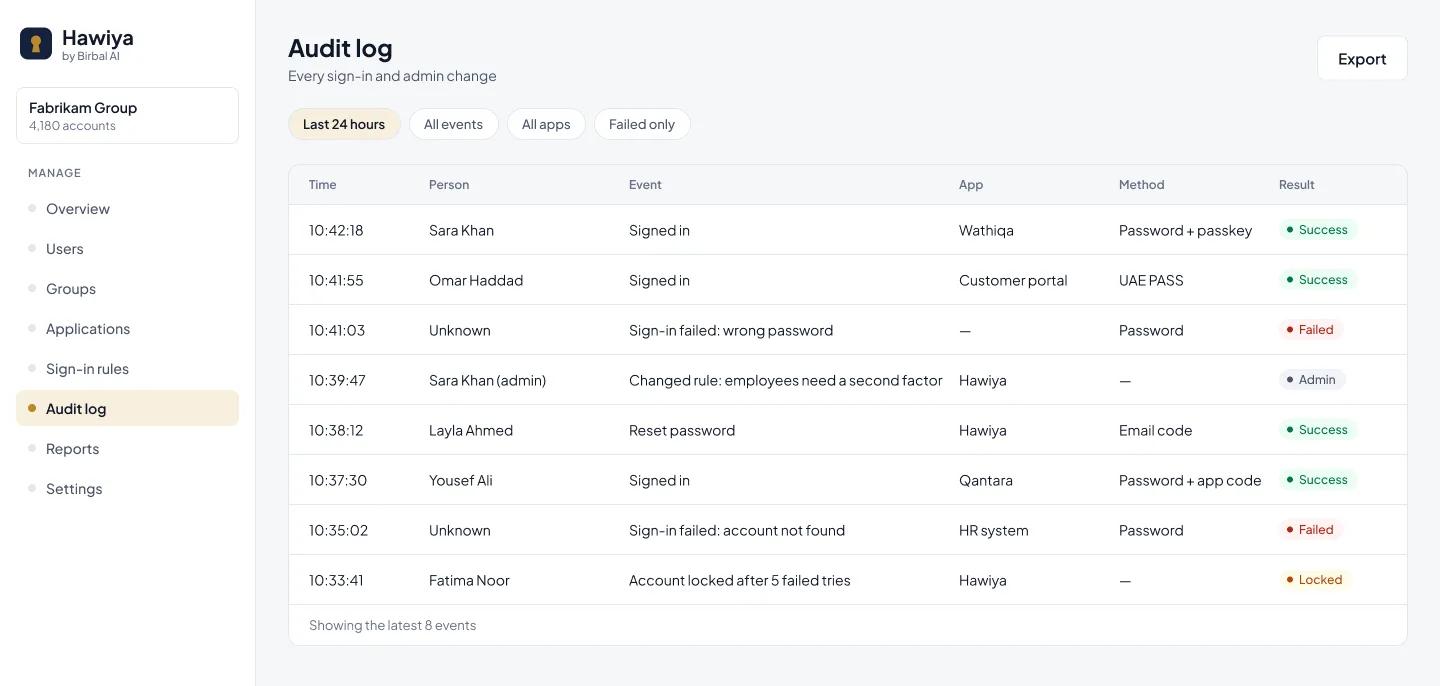
| RBI, paragraph 111 | Privileged access to critical systems managed, logged and monitored through central controls. | Every admin sign-in and change logged and exported to your SOC. Vaulting privileged passwords needs a PAM tool. |
| RBI, paragraph 112 | Controls that minimise invalid logon attempts, and deactivation of dormant accounts. | Lockout after the failed attempts you set, and reports of active users that show the accounts no one uses. |
| RBI, paragraph 113 | Monitoring of abnormal changes in logon patterns. | Repeated failures flagged, and sign-in rules by network, country and new device. |
| CERT-In, direction (iv) | Logs of all ICT systems kept securely for a rolling 180 days, within India. | Hawiya’s sign-in records kept in India: hosted in an Indian cloud region or on your servers. |
CERT-In guidelines
CERT-In compliance: the directions and the MSME controls
CERT-In is India’s national agency for cyber incidents under section 70B of the IT Act.
Directions of 28 April 2022
Service providers, intermediaries, data centres, companies and government organisations must report cyber incidents within 6 hours, keep logs of all ICT systems for a rolling 180 days within India, and synchronise clocks with NIC or NPL time servers.
Controls for MSMEs, 1 September 2025
CERT-In’s 15 elemental controls ask for multi-factor authentication on critical systems, administrative accounts and remote access, unique user IDs, role-based access with least privilege, and lockout after 3 to 5 failed attempts.
Where Hawiya fits
Hawiya covers those sign-in controls for the apps connected to it and keeps its records in India. Incident reporting, and the logs of your other systems, stay with your teams.
Product tour
The rules and the record your auditors ask for
Hawiya screens for a company with employees, contractors and customers.
Privileged users first
Administrators sign in with passkeys only, ideally on security keys.
Access reviews
Review campaigns where a reviewer keeps or removes each person’s access, every decision logged.
Export to your SOC
Send the record to your SIEM or security operations centre.
More for India
Other rules Hawiya is designed to help with in India
Licensing
License Hawiya on your servers or in the cloud
Hawiya is sold as a software licence, not a one-off project. You choose where it runs; the product, updates and support are the same.
On-premise licence
Runs on your servers
Install Hawiya in your data center, in your private cloud tenant or on an isolated network with no internet connection.
- Annual licence, priced by the number of users
- Your data never leaves your network
- Installation, training and updates included
- Support with agreed response times
Cloud subscription
Hosted for you
We run Hawiya for you in a UAE data center, or in a cloud region in your country.
- Monthly or annual subscription, priced by the number of users
- Hosting, backups and monitoring included
- Updates applied for you
- Single sign-on and role-based access
The price depends on the number of users and the support level. We reply within one business day and send a written quote after a short scoping call.
Sources
Where the RBI and CERT-In facts come from
Official texts, checked on 26 November 2026. This is general information, not legal advice.
- RBI: Commercial Banks – Cybersecurity, Technology: Risk, Resilience and Assurance Framework Directions, 2026, 31 July 2026 (rbi.org.in)
- RBI: Non-Banking Financial Companies – Cybersecurity, Technology: Risk, Resilience and Assurance Framework Directions, 2026 (rbi.org.in)
- RBI: Consolidation of supervisory instructions, 628 circulars repealed, 31 July 2026 (rbi.org.in)
- CERT-In: directions under section 70B(6) of the IT Act, 28 April 2022 (cert-in.org.in, PDF)
- CERT-In: 15 Elemental Cyber Defense Controls for MSMEs, 1 September 2025 (cert-in.org.in, PDF)
Book a walkthrough
See the RBI and CERT-In sign-in controls on your apps
Tell us which apps your people use and which rules apply to you. We walk your team through Hawiya, hosted in India or on your servers.
- Hosted in India or on your servers
- Mapped to your apps
- Under NDA if you need one
4.9/5 average rating · 98% client satisfaction · 150+ clients served
FAQ
RBI and CERT-In access controls, answered
Which RBI guidelines cover access control?
Since 31 July 2026, the Cybersecurity, Technology: Risk, Resilience and Assurance Framework Directions, issued separately for commercial banks, payments banks, NBFCs, all-India financial institutions and other regulated entities. Their sections on user access control and teleworking set the rules for authentication, privileged access and remote access.
Does the RBI require multi-factor authentication?
For commercial banks, yes for privileged users of critical information systems and critical activities (paragraph 110) and for teleworkers’ access to critical systems (paragraph 114); elsewhere it follows the bank’s risk assessment. NBFCs in the middle layer and above have matching rules in paragraphs 115 and 116.
What is CERT-In compliance?
Following the directions CERT-In issued under section 70B(6) of the IT Act on 28 April 2022, among them reporting cyber incidents within 6 hours, keeping logs of all ICT systems for 180 days in India and synchronising clocks with NIC or NPL. They apply to service providers, intermediaries, data centres, companies and government organisations.
Can Hawiya keep logs in India?
Yes. Hawiya can be hosted for you in a cloud region in India, or installed on your own servers in India, so its sign-in records stay in India for as long as you set, 180 days or more.
Does Hawiya cover payment authentication?
No. Hawiya signs your staff and customers in to apps and portals. Authentication of payment transactions, such as card or UPI payments, runs in your payment systems under the RBI’s payment directions.
Does Hawiya give us RBI compliance?
No single product does. Hawiya is designed to cover sign-in and access control for the apps connected to it. Your policies, other controls, audits and incident response stay with you.
Does Hawiya replace our PIM or PAM tool?
No. Hawiya signs people in to your apps with passkeys or a second factor and keeps the record. Vaulting privileged passwords and recording admin sessions stay with your PIM or PAM tool.
How is Hawiya licensed?
As an annual on-premise licence installed on your servers, private cloud or an isolated network, or as a monthly or annual cloud subscription that we host in a UAE data center or a cloud region in your country. Both include updates and support.
RBI and CERT-In sign-in controls, kept in India
Book a Hawiya walkthrough for your organisation.
Book a Hawiya walkthrough