Hawiya · SEBI CSCRF access control
SEBI CSCRF access control MFA, password rules and access reviews for regulated entities.
SEBI’s Cybersecurity and Cyber Resilience Framework asks regulated entities for multi-factor authentication on every online sign-in, account lockout, password rules, periodic access reviews and logs of user access kept for at least two years. Hawiya is designed to apply those controls once, for every app your people sign in to, and keep the record, hosted in India or on your own servers.
- MFA for every online sign-in
- Lockout and password rules
- Access records kept two years or more
Authorized vendor to
- Ministry of Finance
- Ministry of Interior
- DGE Abu Dhabi
- Etihad Aviation
- EDGE Group
Delivered for
- Hindustan Unilever
- Nokia
- Linde
- USA Today
- JSL
Procurement-ready
- Emirati national company
- National ICV certificate
- Abu Dhabi Government Procurement Gate
- UAE Ministry of Finance, federal procurement
- Registered ADNOC vendor
The framework
One cybersecurity framework for every SEBI regulated entity
SEBI issued the CSCRF on 20 August 2024, replacing its earlier cybersecurity circulars, with later clarifications.
Five categories
Market infrastructure institutions, qualified regulated entities, mid-size, small-size and self-certification regulated entities, with stricter controls for the larger ones.
Identity and access (PR.AA)
One of its standards areas: identity management, authentication and access control, with standards and guidelines for each category.
Audited
Compliance is checked in cyber audits against the framework’s standards, PR.AA among them.
Control by control
What PR.AA asks, and how Hawiya is designed to help
From SEBI’s circular of 20 August 2024. Hawiya covers sign-in to the apps connected to it; check which guidelines apply to your category.
| Standard | CSCRF asks | Hawiya |
|---|---|---|
| PR.AA.S7, guidelines 1(i) and 1(j) | MFA for critical systems accessed from untrusted networks, and for all users and systems that connect over the internet (all regulated entities). | Sign-in rules that require a passkey or a second factor for every online sign-in, and passkeys only for administrators. |
| Guideline 1(f) | Account lock after failed attempts, for all accounts (all regulated entities). | Lockout after the number of failed attempts you set, with each lockout in the audit log. |
| PR.AA.S6 | An authentication policy with defined password complexity; above small-size entities, a change of password at first login, minimum length, history, complexity, maximum validity and strong hashing. | A password policy with a change at first sign-in, length, character mix, history and expiry, and hashed passwords. |
| PR.AA.S5, guideline 1(g) | User access rights reviewed and documented periodically: quarterly for market infrastructure institutions and qualified entities, half-yearly for others. | Access review campaigns, quarterly or half-yearly: a reviewer keeps or removes each person’s access, and every decision is logged. |
| Guideline 1(h) | End-of-life mechanisms to remove access for users who leave. | One place to turn an account off for every connected app. |
| Guideline 1(e), PR.AA.S9 | User access to critical systems uniquely identified and logged, and the logs kept for at least two years, six months of them online. | Every sign-in and admin change kept per person for the period you set, and exported to your SOC. |
| PR.AA.S4 | A zero-trust model: access to critical systems denied by default and allowed only after authentication and authorisation (not required of small-size and self-certification entities). | Apps reached only through Hawiya’s sign-in, with access to each app given by group. |
| Guideline 3(a) | A PIM solution or process to keep track of privileged access. | Not a PIM tool: Hawiya requires passkeys for administrators and logs their sign-ins, beside your PIM. |
Where the data stays
Kept in India, or on your servers
What CSCRF says
Regulatory data is to be stored and processed within India. IT and cybersecurity data such as logs may go to global security operations centres or SaaS security tools, with approval reviewed every year.
Where Hawiya runs
Hosted for you in a cloud region in India, or on your own servers, so accounts and sign-in records stay in the country.
Product tour
The rules and the record
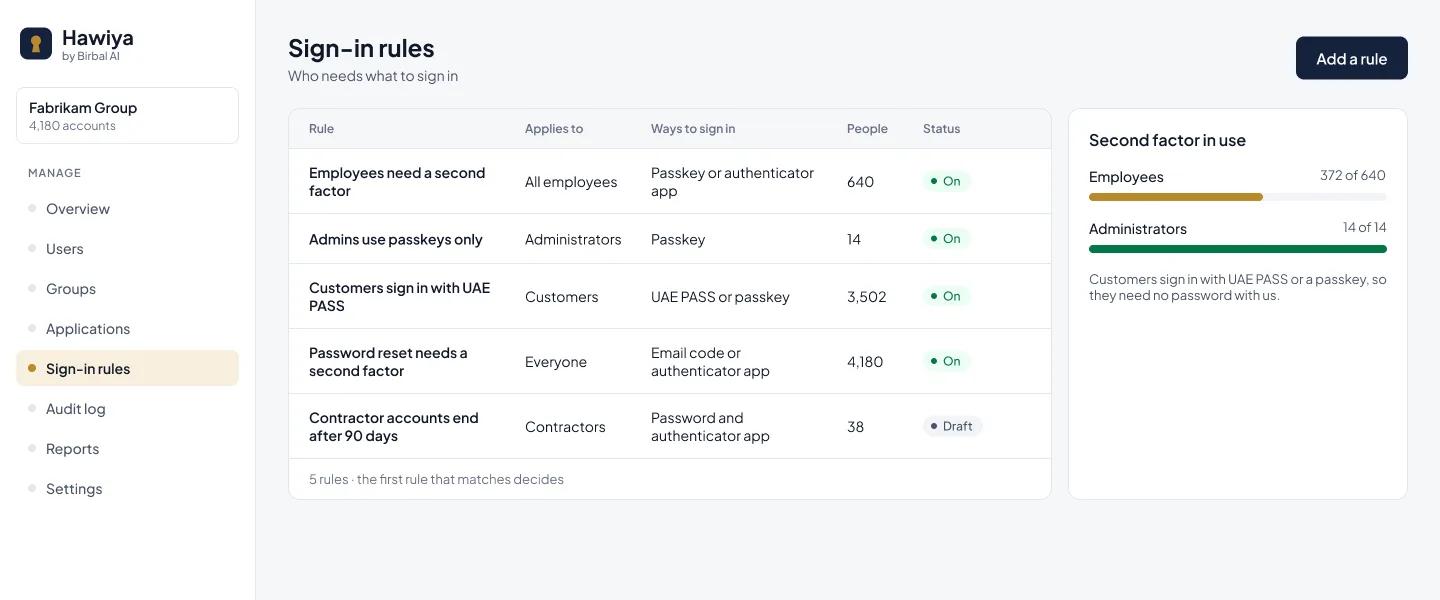
Hawiya screens for a company with employees, contractors and customers.
MFA you can show
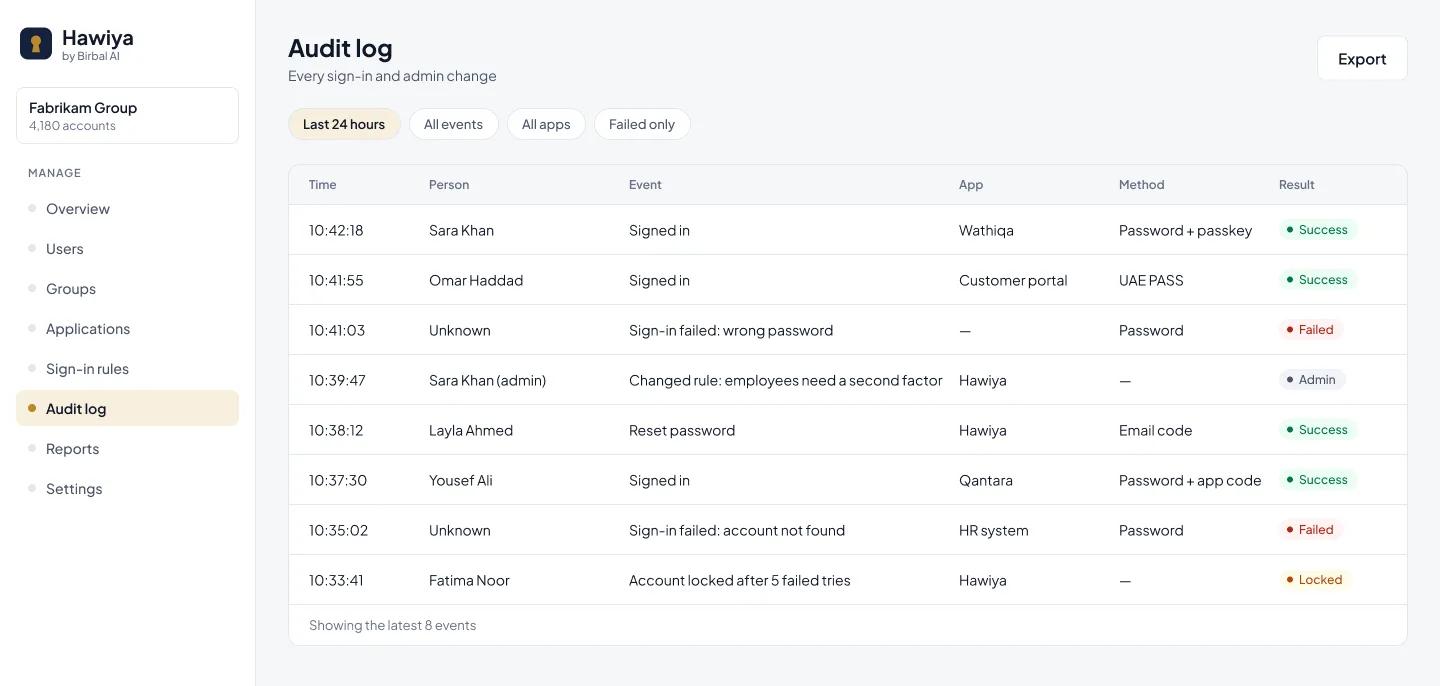
Coverage by group on the rules screen, and the method of every sign-in in the log.
Lockouts on record
Each lockout with the person and the time.
Ready for review
Review campaigns for each app, quarterly or half-yearly, with every decision on record.
Licensing
License Hawiya on your servers or in the cloud
Hawiya is sold as a software licence, not a one-off project. You choose where it runs; the product, updates and support are the same.
On-premise licence
Runs on your servers
Install Hawiya in your data center, in your private cloud tenant or on an isolated network with no internet connection.
- Annual licence, priced by the number of users
- Your data never leaves your network
- Installation, training and updates included
- Support with agreed response times
Cloud subscription
Hosted for you
We run Hawiya for you in a UAE data center, or in a cloud region in your country.
- Monthly or annual subscription, priced by the number of users
- Hosting, backups and monitoring included
- Updates applied for you
- Single sign-on and role-based access
The price depends on the number of users and the support level. We reply within one business day and send a written quote after a short scoping call.
Sources
Where the CSCRF facts come from
SEBI’s circular, checked on 25 November 2026. SEBI has issued clarifications since, so check the current text for your category. This is general information, not legal advice.
Book a walkthrough
See the PR.AA controls set once for every app
Tell us your category and the systems your people use. We walk your IT and security team through the sign-in rules, the lockout and the audit log in Hawiya.
- Mapped to your CSCRF category
- Hosted in India or on your servers
- Under NDA if you need one
4.9/5 average rating · 98% client satisfaction · 150+ clients served
FAQ
SEBI CSCRF access control, answered
What is SEBI CSCRF?
The Cybersecurity and Cyber Resilience Framework that SEBI issued for its regulated entities on 20 August 2024, replacing its earlier cybersecurity circulars. It sets standards and guidelines across governance, identification, protection, detection, response and recovery, by category of entity.
Does CSCRF require multi-factor authentication?
Yes. Standard PR.AA.S7 asks for MFA on critical systems for users connecting from untrusted networks, and the guidelines ask all regulated entities to enable MFA for all users and systems that connect over the internet.
How long must access logs be kept under CSCRF?
At least two years, with at least six months online and the rest archived, for logs of user access to critical systems.
Does Hawiya give us SEBI CSCRF compliance?
No single product does. Hawiya is designed to cover the sign-in controls of PR.AA for the apps connected to it. The framework also asks for a SOC, vulnerability testing, audits, incident response and more.
Is Hawiya a PIM or PAM tool?
No. Hawiya enforces passkeys for administrators and logs their sign-ins, and works beside the PIM solution or process the framework asks for.
How is Hawiya licensed?
As an annual on-premise licence installed on your servers, private cloud or an isolated network, or as a monthly or annual cloud subscription that we host in a UAE data center or a cloud region in your country. Both include updates and support.