Hawiya · هوية · A guide
SAML vs OAuth vs OpenID Connect which to use for single sign-on, apps and APIs.
All three let one service vouch for a person so that another can trust it, but they answer different questions. SAML 2.0 signs people in to business web apps. OAuth 2.0 lets an app reach an API on someone’s behalf. OpenID Connect adds sign-in on top of OAuth 2.0 for web and mobile apps. Hawiya speaks SAML 2.0 and OpenID Connect, so almost any business app can sign in through it.
- SAML 2.0 for business web apps
- OpenID Connect for web and mobile
- OAuth 2.0 tokens for your APIs
Authorized vendor to
- Ministry of Finance
- Ministry of Interior
- DGE Abu Dhabi
- Etihad Aviation
- EDGE Group
Delivered for
- Hindustan Unilever
- Nokia
- Linde
- USA Today
- JSL
Procurement-ready
- Emirati national company
- National ICV certificate
- Abu Dhabi Government Procurement Gate
- UAE Ministry of Finance, federal procurement
- Registered ADNOC vendor
Side by side
SAML, OAuth and OpenID Connect compared
What each standard is for, who publishes it, and where it fits.
| Question | OpenID Connect | SAML 2.0 | OAuth 2.0 |
|---|---|---|---|
| What it is for | Signing people in to web and mobile apps | Signing people in to business web apps | Letting an app reach an API on someone’s behalf, or on its own |
| The question it answers | Who is this person? | Who is this person, and what do we know about them? | What may this app do? |
| Who publishes it | OpenID Foundation; also ISO/IEC 26131:2024 | OASIS, an OASIS Standard since March 2005 | IETF, RFC 6749, October 2012 |
| What the app receives | An ID token, a signed JSON Web Token, and an access token if needed | A signed XML assertion | An access token |
| Best for | New web apps, mobile apps and single-page apps | Established business and SaaS apps that offer it | Your own APIs and app-to-app access |
| In Hawiya | Yes | Yes | Yes, as the base of OpenID Connect, with tokens your APIs can check |
In plain words
What SAML, OAuth and OpenID Connect each do
SAML 2.0
The Security Assertion Markup Language, an OASIS Standard since March 2005. When someone opens an app, the app sends them to the identity provider, which signs them in and returns a signed XML statement of who they are. Most established business apps support it.
OAuth 2.0
An authorization framework, published by the IETF as RFC 6749 in October 2012. It lets an app get limited access to an API with an access token instead of the person’s password. On its own it does not tell the app who the person is.
OpenID Connect
A simple identity layer on top of OAuth 2.0, from the OpenID Foundation, also published as the international standard ISO/IEC 26131:2024. The app receives an ID token that says who signed in, which suits modern web and mobile apps.
Choosing
Which one should your app use?
- 01
The app offers only SAML
Use SAML 2.0. Many established business apps have a SAML setting in their admin console.
- 02
You are building a web or mobile app
Use OpenID Connect. There are libraries for every major language, and mobile apps can sign in through the phone’s browser.
- 03
Your app calls an API
Use OAuth 2.0 access tokens, issued by the same identity provider that signs people in.
- 04
The app offers both
Prefer OpenID Connect for new connections, and keep SAML where it already works.
In Hawiya
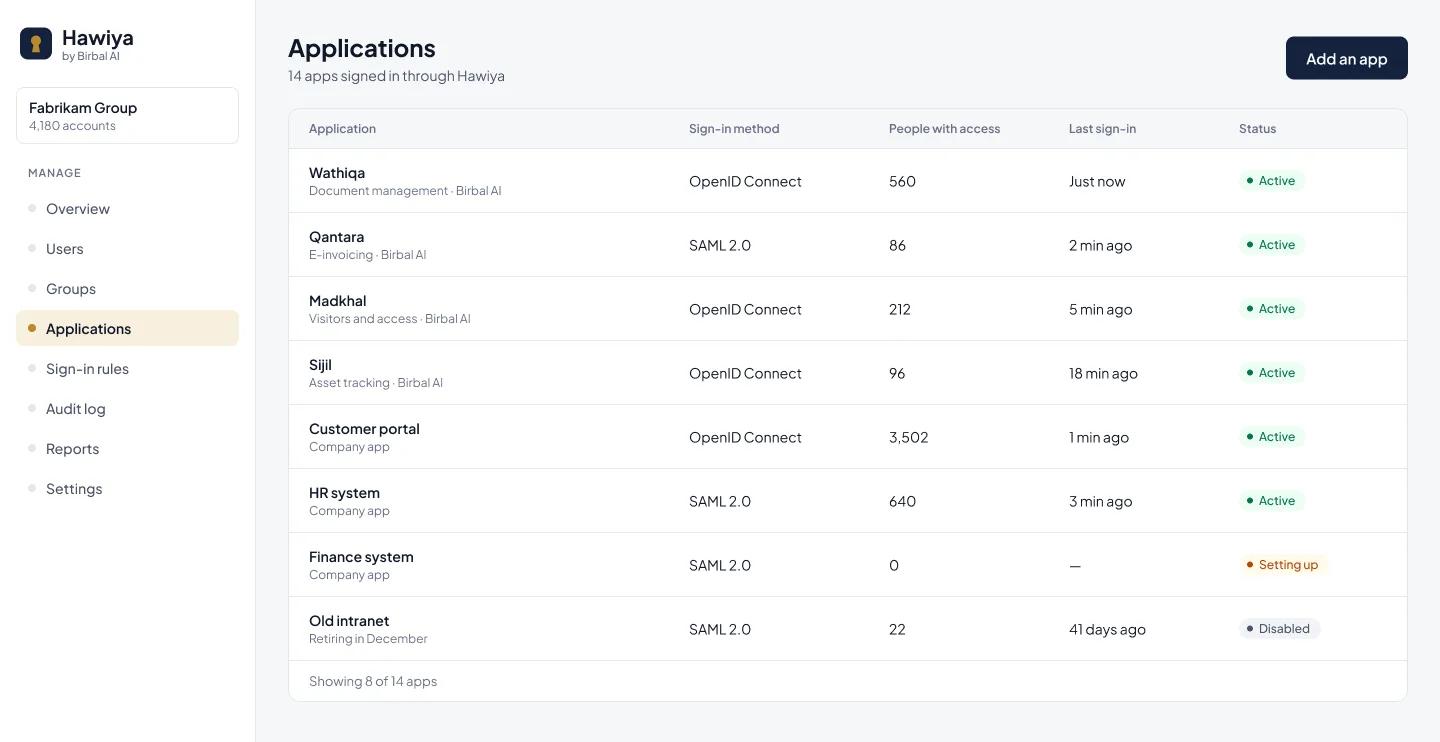
One identity provider for SAML and OpenID Connect apps
Both standards, one sign-in
Apps on SAML 2.0 and apps on OpenID Connect trust the same Hawiya sign-in, with the same second factor and the same rules.
Tokens for your APIs
Your own APIs can check the access tokens Hawiya issues, so apps and services share one sign-in.
Tested templates
Templates for common apps, starting with Microsoft 365 and Google Workspace, so a connection doesn’t start from a blank form.
Product tour
See Hawiya at work
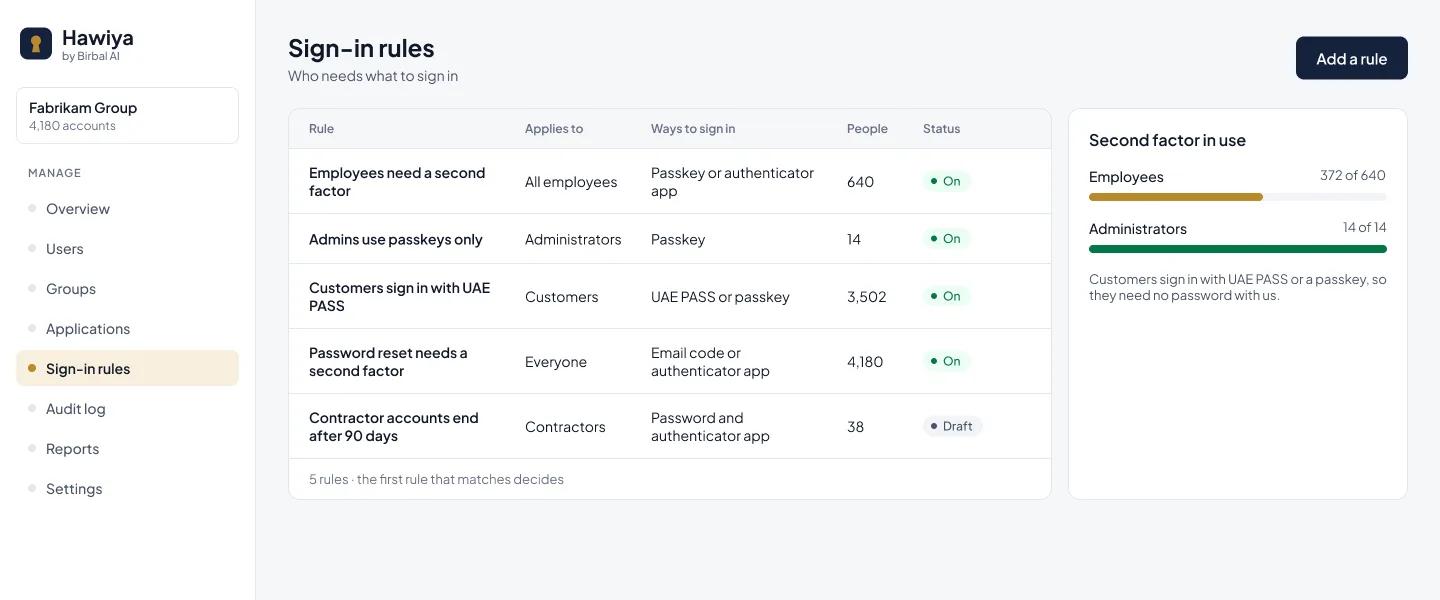
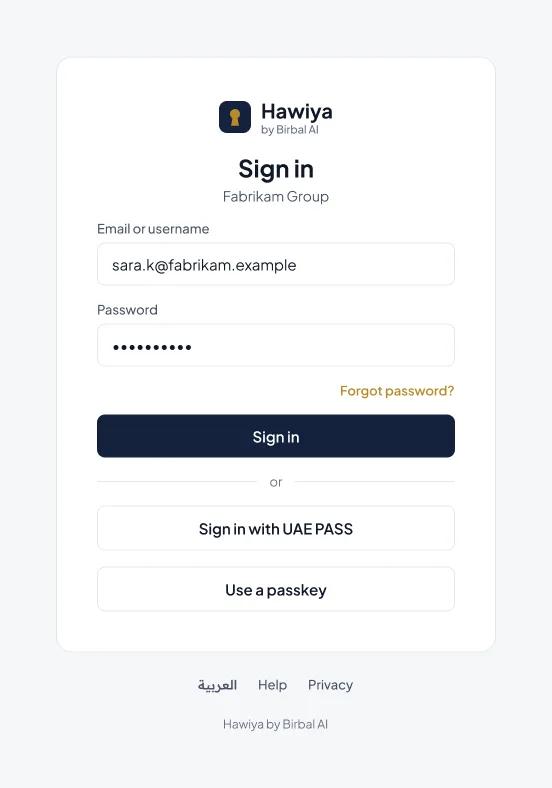
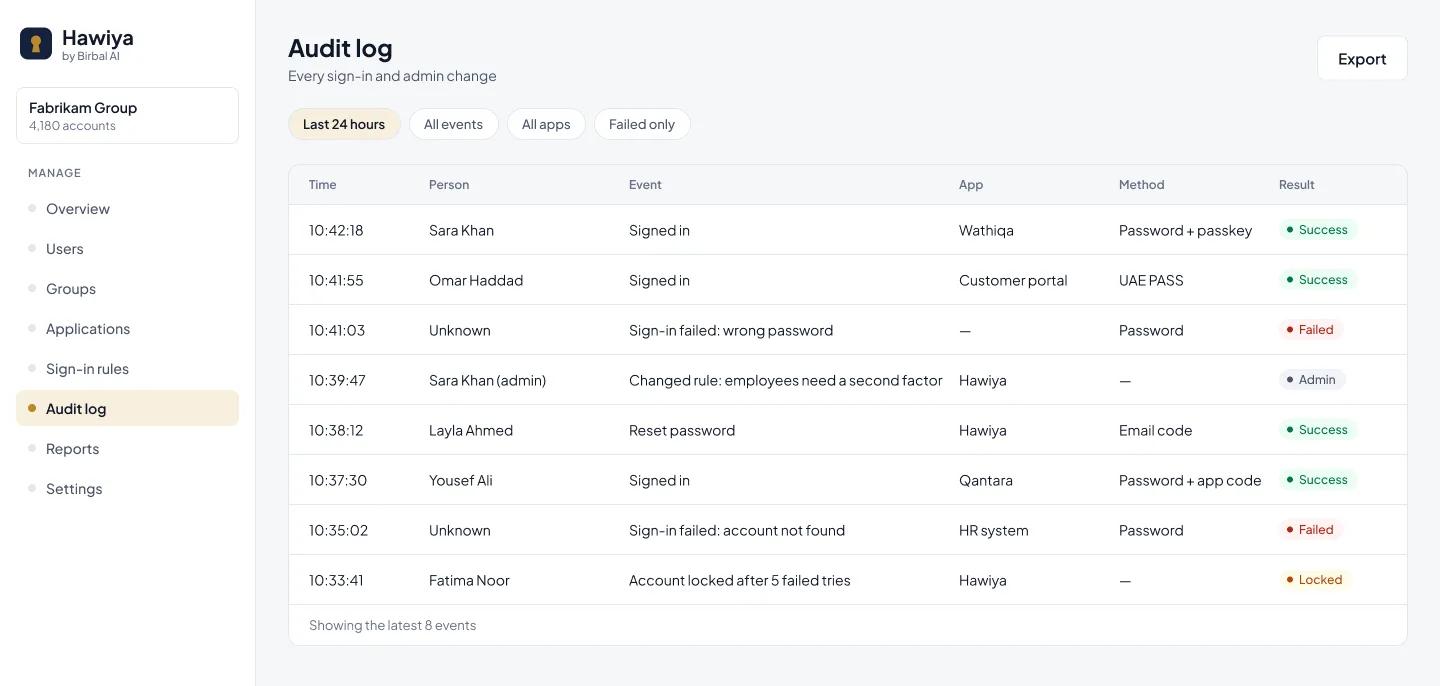
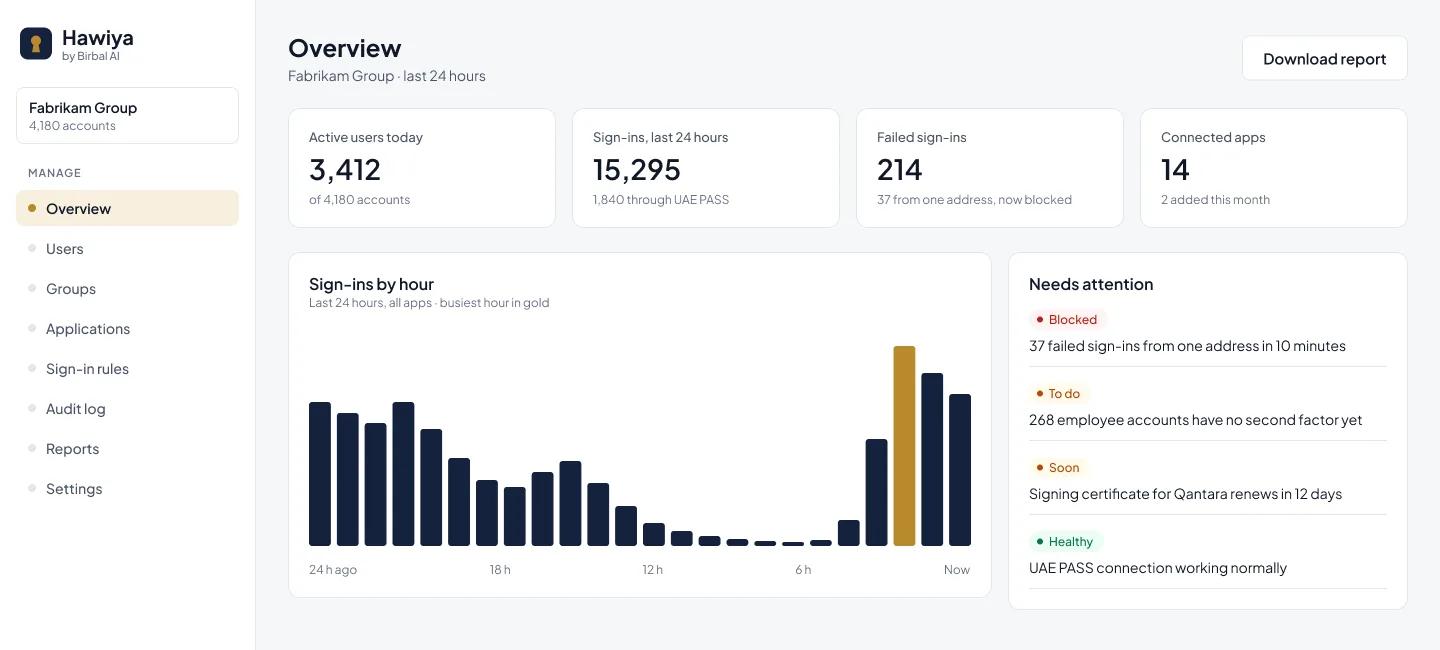
Hawiya screens for a company with employees, contractors and customers.
One sign-in for every app
People sign in once, and connected apps trust that sign-in over SAML 2.0 or OpenID Connect.
Clear rules for each group
Each group gets the ways to sign in it is allowed, and the first rule that matches decides.
Everything on record
Every sign-in and admin change goes in the audit log, with the person, the time and the result.
Licensing
License Hawiya on your servers or in the cloud
Hawiya is sold as a software licence, not a one-off project. You choose where it runs; the product, updates and support are the same.
On-premise licence
Runs on your servers
Install Hawiya in your data center, in your private cloud tenant or on an isolated network with no internet connection.
- Annual licence, priced by the number of users
- Your data never leaves your network
- Installation, training and updates included
- Support with agreed response times
Cloud subscription
Hosted for you
We run Hawiya for you in a UAE data center, or in a cloud region in your country.
- Monthly or annual subscription, priced by the number of users
- Hosting, backups and monitoring included
- Updates applied for you
- Single sign-on and role-based access
The price depends on the number of users and the support level. We reply within one business day and send a written quote after a short scoping call.
Sources
Where the standards facts come from
The specifications themselves, checked on 26 November 2026.
- OASIS: SAML V2.0 core specification, OASIS Standard of 15 March 2005 (docs.oasis-open.org, PDF)
- IETF: RFC 6749, The OAuth 2.0 Authorization Framework, October 2012 (rfc-editor.org)
- OpenID Foundation: OpenID Connect Core 1.0, incorporating errata set 2 (openid.net)
- ISO/IEC 26131:2024: OpenID Connect Core 1.0 as an international standard (iso.org)
Book a walkthrough
See your apps connected over SAML and OpenID Connect
Send us the list of apps your people use. We show which connect over SAML 2.0, which over OpenID Connect, and how they share one sign-in in Hawiya.
- Your app list, mapped
- In Arabic or English
- Under NDA if you need one
4.9/5 average rating · 98% client satisfaction · 150+ clients served
FAQ
SAML, OAuth and OpenID Connect, answered
What is SAML?
The Security Assertion Markup Language, an XML-based standard from OASIS. SAML 2.0, an OASIS Standard since March 2005, lets an identity provider sign a person in and tell a business app who they are, which is how single sign-on works in many established apps.
What is OAuth?
OAuth 2.0 is an authorization framework, published by the IETF as RFC 6749 in October 2012. It lets an app get limited access to an API, for a person or for itself, with an access token instead of a password.
What is OpenID Connect?
A simple identity layer on top of OAuth 2.0, from the OpenID Foundation. It adds an ID token that tells the app who signed in, so it is used for sign-in to web and mobile apps. OpenID Connect Core 1.0 is also published as ISO/IEC 26131:2024.
What is the difference between OAuth and OpenID Connect?
OAuth 2.0 grants an app access to an API; it was not built to tell the app who the person is. OpenID Connect builds on OAuth 2.0 and adds an ID token that does. Use OpenID Connect for sign-in, and OAuth 2.0 access tokens for API calls.
Is SAML outdated?
No. It is older and built on XML, but it is still the sign-in option many established business and SaaS apps offer, and identity providers keep supporting it. New apps usually choose OpenID Connect.
Which is more secure, SAML or OpenID Connect?
Both are secure when set up properly: signed responses, checked audiences and short lifetimes. Most problems come from how an app checks what it receives, which is why tested app templates matter.
Does Hawiya support SAML and OpenID Connect?
Yes. Hawiya signs people in to apps over SAML 2.0 and OpenID Connect, and issues OAuth 2.0 access tokens your own APIs can check. It is built on Keycloak, which supports all three.
What about SCIM?
SCIM is a different standard, for creating and removing user accounts rather than signing in. Hawiya is designed to accept users from HR systems over SCIM.
How is Hawiya licensed?
As an annual on-premise licence installed on your servers, private cloud or an isolated network, or as a monthly or annual cloud subscription that we host in a UAE data center or a cloud region in your country. Both include updates and support.
SAML and OpenID Connect apps, one sign-in
Book a Hawiya walkthrough with your app list.
Book a Hawiya walkthrough