Hawiya · هوية · Saudi Arabia
NCA ECC identity and access controls and PDPL safeguards, on your servers in the Kingdom.
NCA’s Essential Cybersecurity Controls (ECC-2:2024) ask government entities and operators of critical national infrastructure for multi-factor authentication on remote and privileged access, least privilege, periodic review of access rights, and at least 12 months of security event logs. Hawiya is designed to apply those controls once, for every app your people sign in to, in Arabic and English, on servers you run in the Kingdom.
- MFA for remote and privileged access
- Access reviews with every decision logged
- Arabic first, on your servers
Authorized vendor to
- Ministry of Finance
- Ministry of Interior
- DGE Abu Dhabi
- Etihad Aviation
- EDGE Group
Delivered for
- Hindustan Unilever
- Nokia
- Linde
- USA Today
- JSL
Procurement-ready
- Emirati national company
- National ICV certificate
- Abu Dhabi Government Procurement Gate
- UAE Ministry of Finance, federal procurement
- Registered ADNOC vendor
Who it applies to
Who the NCA cybersecurity controls apply to
The ECC set the minimum cybersecurity requirements for national entities. ECC-2:2024 updated the first edition, ECC-1:2018.
Government entities
Ministries, authorities, establishments and other government bodies in the Kingdom, and the entities affiliated with them.
Critical infrastructure
Private sector organisations that own, operate or host critical national infrastructure.
Other organisations
Everyone else is encouraged to adopt the controls. Each entity in scope must comply with all the controls that apply to it.
Control by control
ECC-2:2024 identity and access controls, and how Hawiya is designed to help
Hawiya covers sign-in to the apps connected to it. Your policies, the other ECC domains and each app’s own settings stay with you.
| Control | The control asks | Hawiya |
|---|---|---|
| 2-2-3-1 | Single-factor authentication based on username and password. | Password and lockout rules, with passwords checked in your Active Directory or LDAP. |
| 2-2-3-2 | Multi-factor authentication for remote access and privileged accounts, with suitable factors and their number defined. | A second factor for sign-ins from outside your network, and passkeys only for administrators, set by rule for each group. |
| 2-2-3-3 | Authorisation on need-to-know and need-to-use, least privilege and segregation of duties. | Access to each app by group or role, and administration delegated per department, entity or branch. |
| 2-2-3-4 | Privileged access management. | Passkeys for administrators and every admin sign-in logged. Vaulting privileged passwords and recording sessions need a PAM tool. |
| 2-2-3-5 | Periodic review of identities and access rights. | Access review campaigns: a reviewer keeps or removes each person’s access, and every decision is logged. |
| 2-12-3-2 and 2-12-3-5 | Event logs for critical and privileged accounts and for remote access, kept for at least 12 months. | Every sign-in and admin change on record, kept for 12 months or longer, and exported to your security monitoring. |
PDPL
What the PDPL asks, and where sign-in fits
The Personal Data Protection Law covers processing of personal data in the Kingdom, and of people residing in the Kingdom by parties outside it.
Security measures
Article 19: the controller implements the necessary organisational, administrative and technical measures to protect personal data, including when it is transferred.
Breach notification
Article 20: the controller notifies the competent authority of any breach, damage or illegal access, and informs the people affected where it could harm them.
Transfers outside the Kingdom
Article 29 sets the purposes and conditions for transferring personal data outside the Kingdom. Hawiya on your servers keeps sign-in records in the Kingdom.
Getting there
From the ECC preset to audit evidence
- 01
Apply the NCA ECC preset
One step sets second factors, lockout, session length and log retention to match the ECC, and you adjust from there.
- 02
Connect directory and apps
Active Directory or LDAP, and your apps over SAML 2.0 or OpenID Connect.
- 03
Run the first access review
Reviewers keep or remove each person’s access to each app, and every decision goes on record.
- 04
Hand over the evidence
Export sign-in records, rule settings and review decisions for your ECC assessment.
Product tour
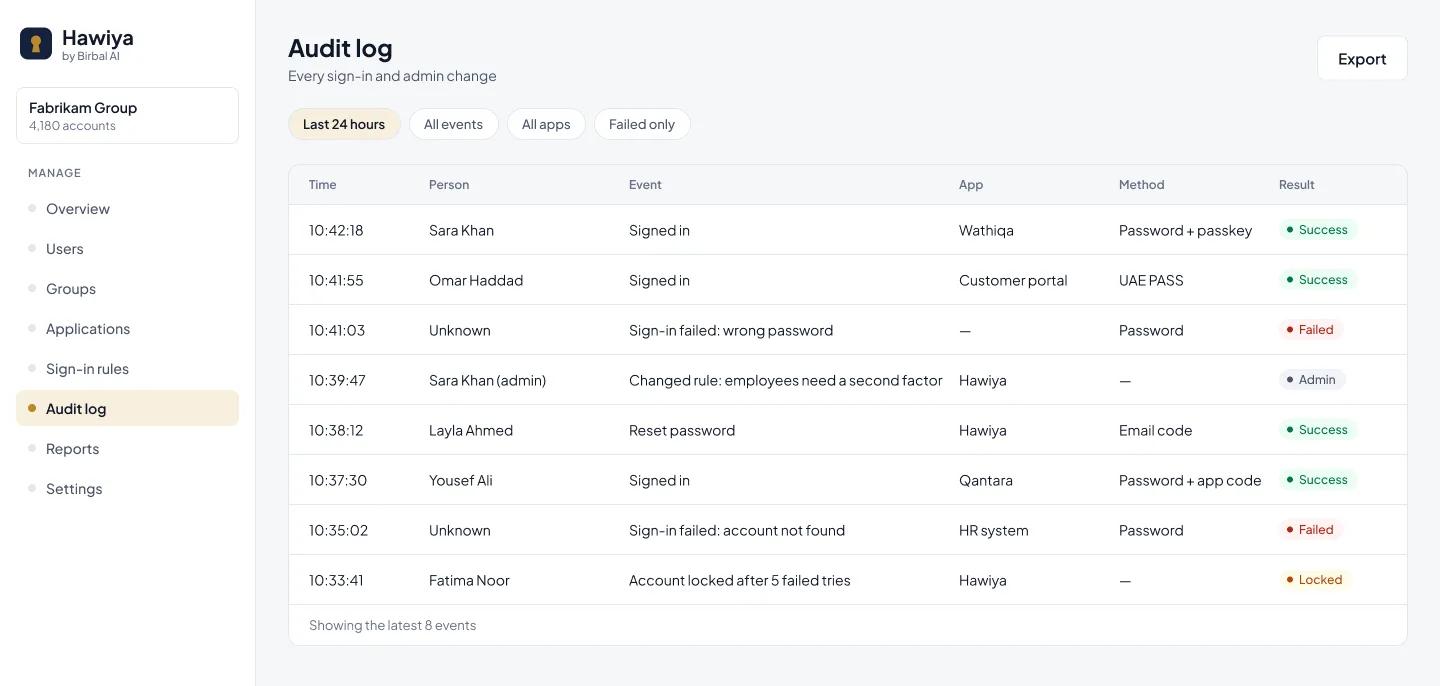
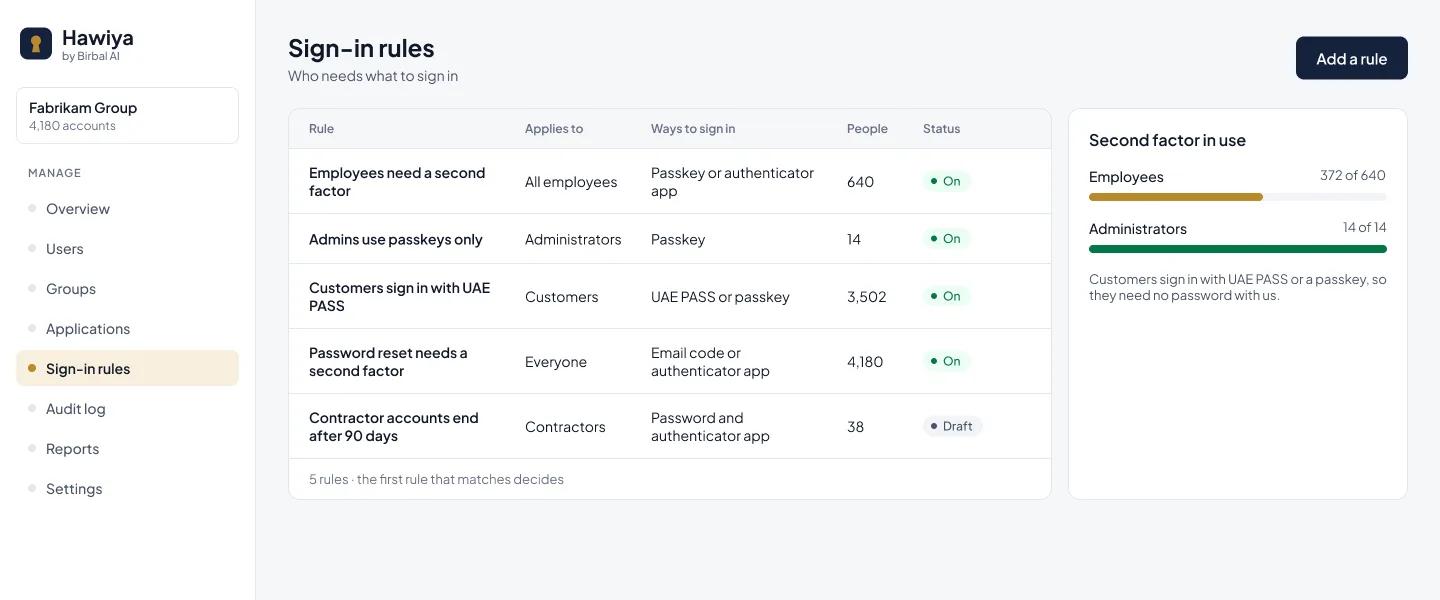
The rules and the record your auditors ask for
Hawiya screens for a company with employees, contractors and customers.
Arabic first
Sign-in pages, emails and the admin console in Arabic and English, right to left.
Rules for each group
Employees, administrators and contractors each get their own way in.
Twelve months and more
Sign-in records kept for the period you set, and exported to your SOC.
Licensing
License Hawiya on your servers or in the cloud
Hawiya is sold as a software licence, not a one-off project. You choose where it runs; the product, updates and support are the same.
On-premise licence
Runs on your servers
Install Hawiya in your data center, in your private cloud tenant or on an isolated network with no internet connection.
- Annual licence, priced by the number of users
- Your data never leaves your network
- Installation, training and updates included
- Support with agreed response times
Cloud subscription
Hosted for you
We run Hawiya for you in a UAE data center, or in a cloud region in your country.
- Monthly or annual subscription, priced by the number of users
- Hosting, backups and monitoring included
- Updates applied for you
- Single sign-on and role-based access
The price depends on the number of users and the support level. We reply within one business day and send a written quote after a short scoping call.
Sources
Where the control and law facts come from
Official texts, checked on 26 November 2026. This is general information, not legal advice.
Book a walkthrough
See the ECC identity controls set up for your apps
Tell us which apps your people use and where your data must stay. We walk your team through Hawiya in Arabic or English, installed on servers in the Kingdom.
- On your servers in the Kingdom
- In Arabic or English
- Under NDA if you need one
4.9/5 average rating · 98% client satisfaction · 150+ clients served
FAQ
NCA ECC and the PDPL, answered
What is NCA ECC?
The Essential Cybersecurity Controls issued by Saudi Arabia’s National Cybersecurity Authority: the minimum cybersecurity requirements for government entities and operators of critical national infrastructure. The current edition, ECC-2:2024, updated ECC-1:2018.
Does the ECC require multi-factor authentication?
Yes. Control 2-2-3-2 asks for multi-factor authentication for remote access and for privileged accounts, with the suitable factors and their number defined by the entity.
How long must logs be kept under the ECC?
Control 2-12-3-5 sets a retention period of at least 12 months for cybersecurity event logs. Hawiya keeps sign-in records for the period you set and exports them to your security monitoring.
Does Hawiya make us NCA ECC compliant?
No single product does. Hawiya is designed to cover the identity and access controls in subdomain 2-2 for the apps connected to it, and the sign-in part of the event logs in 2-12. The other domains, your policies and their periodic review stay with you.
Is the PDPL Saudi Arabia’s GDPR?
It plays a similar role. The Personal Data Protection Law governs processing of personal data in the Kingdom, and of people residing there by parties abroad, with duties on security, breach notification and transfers outside the Kingdom. Its details differ from the GDPR, so check them with your legal advisers.
Can Hawiya run inside the Kingdom?
Yes. Hawiya is designed to be installed on your own servers in the Kingdom, including networks with no internet connection, so sign-in records stay on your network. It can also be hosted for you in a cloud region in the Kingdom.
Does Hawiya support Nafath?
Not in version 1. People sign in to Hawiya with passwords, passkeys, security keys and authenticator apps, and through your Active Directory or LDAP.
Does Hawiya replace our PAM tool?
No. Hawiya signs people in to your apps with passkeys or a second factor and keeps the record. Vaulting privileged passwords and recording admin sessions, which control 2-2-3-4 also covers, stay with your PAM tool.
How is Hawiya licensed?
As an annual on-premise licence installed on your servers, private cloud or an isolated network, or as a monthly or annual cloud subscription that we host in a UAE data center or a cloud region in your country. Both include updates and support.
The ECC identity controls, kept in the Kingdom
Book a Hawiya walkthrough for your organisation.
Book a Hawiya walkthrough