Hawiya · هوية · SCIM
SCIM user provisioning joiners and leavers from your HR system, in every app at once.
When someone joins, moves or leaves, the change is made in your HR system first. Hawiya is designed to accept those changes over SCIM, the IETF standard for creating, updating and removing user accounts: a joiner gets an account and their groups, and a leaver’s account is turned off, so every app behind Hawiya’s single sign-on closes to them at once. It uses the SCIM API that Keycloak, which Hawiya is built on, made a supported feature in version 26.8.
- Accounts follow the HR record
- Leavers lose every app at once
- The open SCIM 2.0 standard
Authorized vendor to
- Ministry of Finance
- Ministry of Interior
- DGE Abu Dhabi
- Etihad Aviation
- EDGE Group
Delivered for
- Hindustan Unilever
- Nokia
- Linde
- USA Today
- JSL
Procurement-ready
- Emirati national company
- National ICV certificate
- Abu Dhabi Government Procurement Gate
- UAE Ministry of Finance, federal procurement
- Registered ADNOC vendor
How it works
How SCIM user provisioning works with Hawiya
- 01
HR sends the change
A joiner, a move or a leaver is sent to Hawiya over SCIM, as a create, an update or a deactivation.
- 02
Hawiya updates the account
The account, its details and its groups change in Hawiya, and the change goes in the audit log.
- 03
Groups decide access
Group membership decides which apps the person can open through Hawiya.
- 04
Leavers lose every app
A deactivated account can’t sign in, so every app behind Hawiya closes to the person at once.
SCIM
What SCIM is, and what it is not
A standard from 2015
The System for Cross-domain Identity Management, published by the IETF as RFC 7643 and RFC 7644 in September 2015: a common schema for users and groups, and an HTTP protocol to create, read, update and remove them.
Not a sign-in standard
SCIM moves accounts; SAML 2.0 and OpenID Connect sign people in. Most organisations need both.
Inbound and outbound
Inbound, another system such as your HR system sends users to Hawiya. Outbound, Hawiya would create accounts inside each app. Hawiya version 1 does inbound.
Compared
Three ways to get users into Hawiya
All three are in version 1. Many organisations use the one that matches where their people are kept today.
| Question | SCIM from HR | Active Directory or LDAP | Sign-in through Entra ID or Google |
|---|---|---|---|
| Where people are kept | Your HR system | Your directory | Microsoft or Google accounts |
| When an account appears | When HR sends the joiner | When Hawiya reads the directory | At the person’s first sign-in |
| When a leaver loses access | When HR sends the leaver | At the next sign-in once the account is disabled in the directory | Once their Microsoft or Google account is blocked |
| Groups | Sent by HR over SCIM | Read from directory groups | Set in Hawiya |
Accounts inside each app
What about accounts inside each app?
Apps behind single sign-on
Apps that sign in through Hawiya keep no password of their own, and many can create the account at the person’s first sign-in.
Outbound SCIM
Hawiya creating and removing accounts inside each app over SCIM is not in version 1.
Leavers in the meantime
A leaver still loses every app behind Hawiya at once, even where an account inside an app is left to tidy up.
Product tour
See Hawiya at work
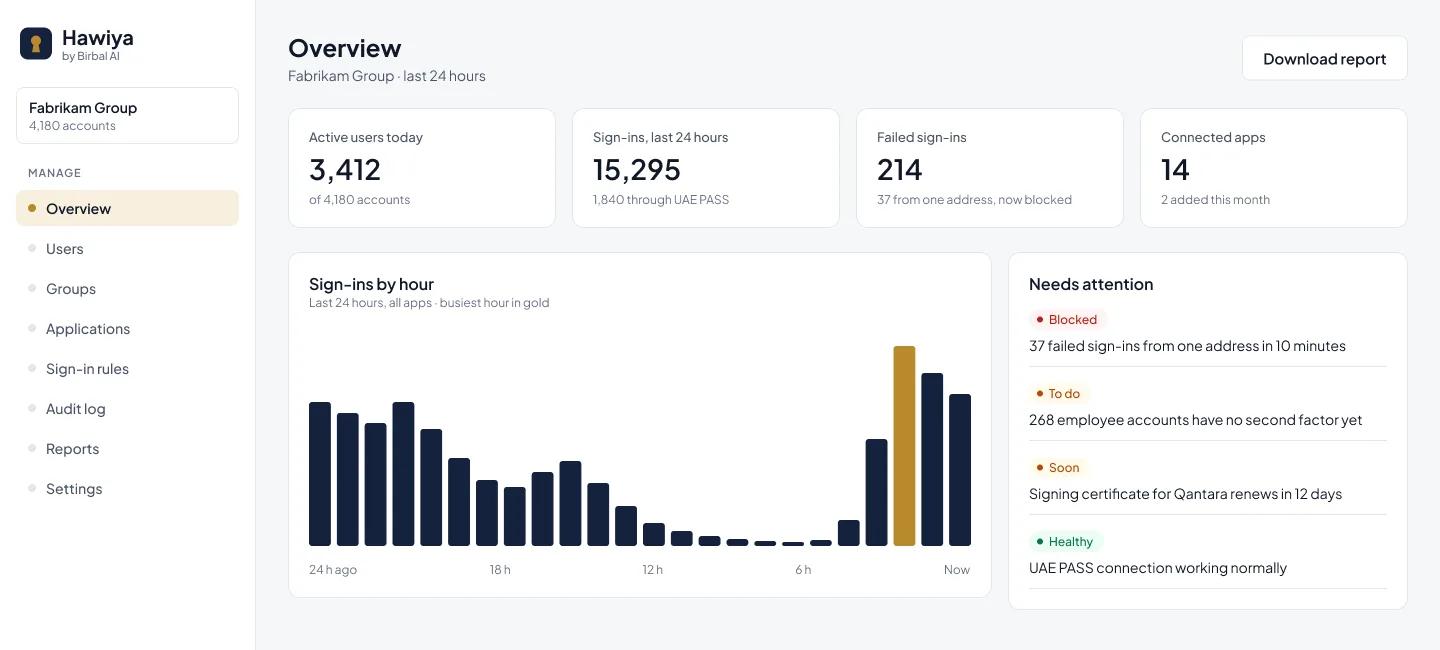
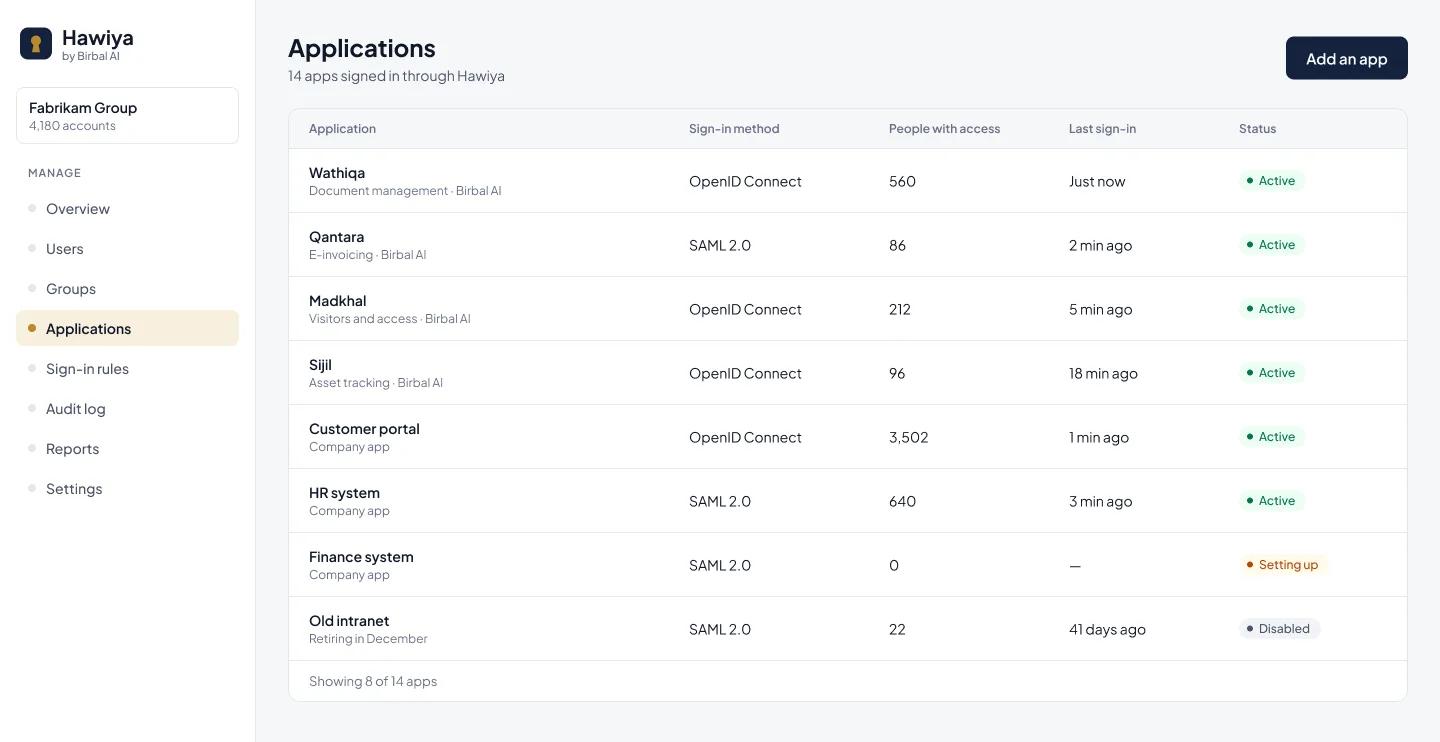
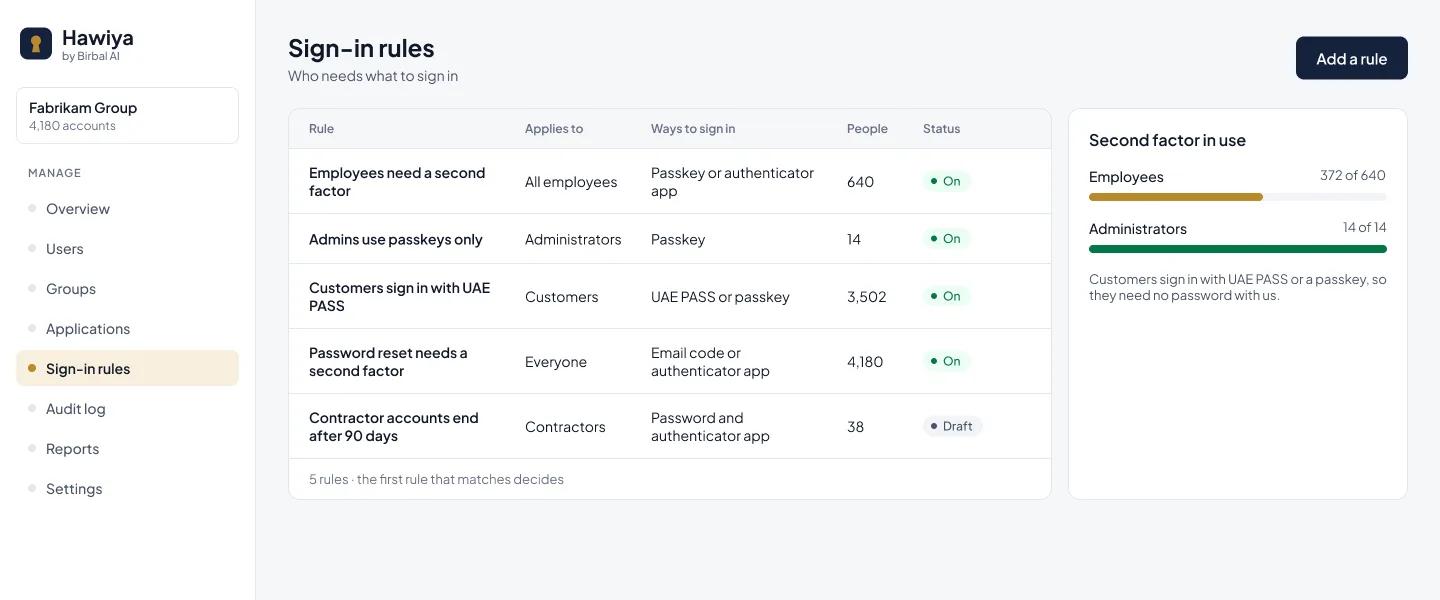
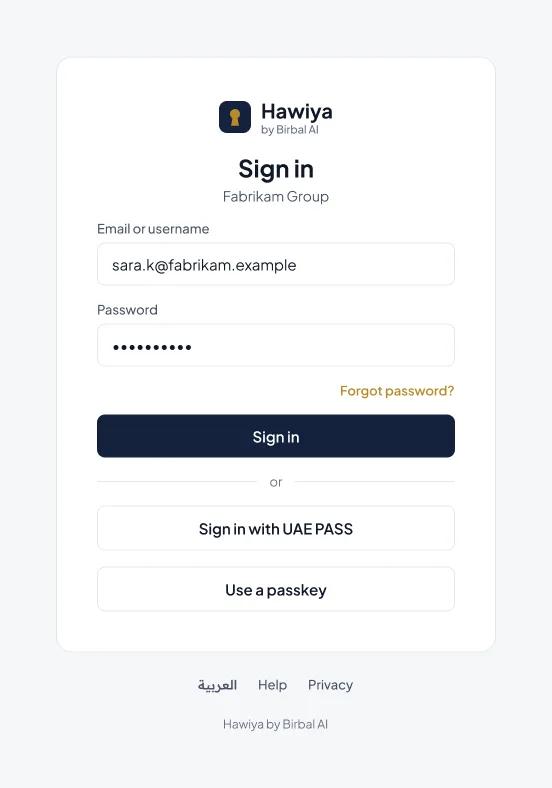
Hawiya screens for a company with employees, contractors and customers.
One sign-in for every app
People sign in once, and connected apps trust that sign-in over SAML 2.0 or OpenID Connect.
Clear rules for each group
Each group gets the ways to sign in it is allowed, and the first rule that matches decides.
Everything on record
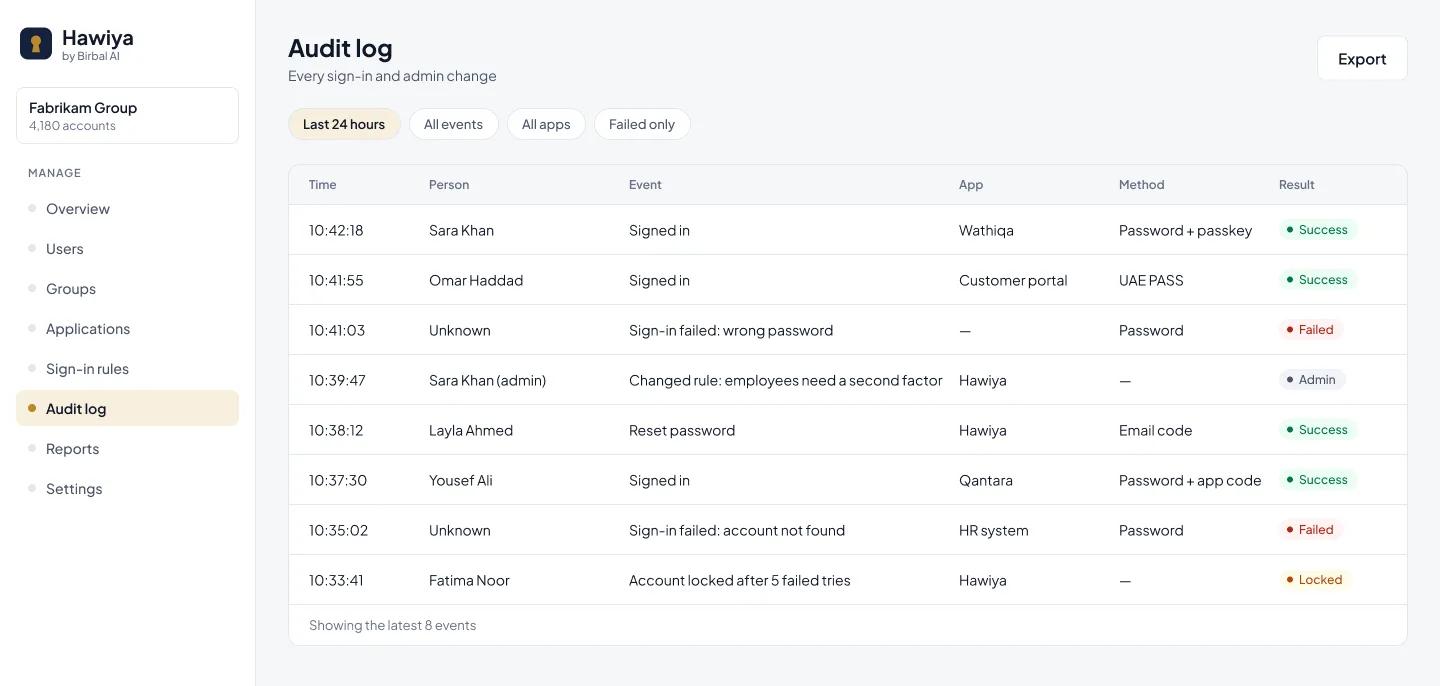
Every sign-in and admin change goes in the audit log, with the person, the time and the result.
Licensing
License Hawiya on your servers or in the cloud
Hawiya is sold as a software licence, not a one-off project. You choose where it runs; the product, updates and support are the same.
On-premise licence
Runs on your servers
Install Hawiya in your data center, in your private cloud tenant or on an isolated network with no internet connection.
- Annual licence, priced by the number of users
- Your data never leaves your network
- Installation, training and updates included
- Support with agreed response times
Cloud subscription
Hosted for you
We run Hawiya for you in a UAE data center, or in a cloud region in your country.
- Monthly or annual subscription, priced by the number of users
- Hosting, backups and monitoring included
- Updates applied for you
- Single sign-on and role-based access
The price depends on the number of users and the support level. We reply within one business day and send a written quote after a short scoping call.
Sources
Where the SCIM facts come from
Checked on 26 November 2026.
Book a walkthrough
See a joiner and a leaver flow from HR to every app
Tell us which HR system and directory you use. We show a joiner and a leaver arriving over SCIM, and what changes in every app behind Hawiya, in Arabic or English.
- Your HR system and apps
- In Arabic or English
- Under NDA if you need one
4.9/5 average rating · 98% client satisfaction · 150+ clients served
FAQ
SCIM user provisioning, answered
What is SCIM?
The System for Cross-domain Identity Management, an IETF standard published in September 2015 as RFC 7643 and RFC 7644. It gives systems a common way to create, update and remove user accounts and groups over HTTP.
What is user provisioning?
Creating, updating and removing user accounts as people join, move and leave, ideally driven by the HR system rather than by hand. With Hawiya, the HR system sends those changes over SCIM, and every app behind Hawiya’s sign-in follows.
Which HR systems work with Hawiya?
Any HR system or directory that can send users and groups over SCIM 2.0. We check yours during the walkthrough.
Does Hawiya create accounts inside apps over SCIM?
Not in version 1. Hawiya receives users over SCIM; creating accounts inside each app is not part of version 1. Apps behind Hawiya’s single sign-on still close to a leaver at once.
What is the difference between SCIM and SAML?
SAML 2.0 signs a person in to an app; SCIM creates and removes the person’s account. Hawiya uses SAML 2.0 and OpenID Connect for sign-in, and accepts SCIM for accounts.
Is every change recorded?
Yes. Each account created, changed or turned off over SCIM goes in the audit log with the time, beside every sign-in.
How is Hawiya licensed?
As an annual on-premise licence installed on your servers, private cloud or an isolated network, or as a monthly or annual cloud subscription that we host in a UAE data center or a cloud region in your country. Both include updates and support.
Accounts that follow the HR record
Book a Hawiya walkthrough with your HR system.
Book a Hawiya walkthrough