Free template · Patch management
Patch management policy template based on NIST and CIS Controls.
Download a patch management policy in Word, in English and Arabic: scope, roles, priorities and target times, testing, exceptions, and a section for isolated and air-gapped networks. Based on NIST SP 800-40 and CIS Controls v8.
- Word, in English and Arabic
- Based on NIST SP 800-40 Rev. 4
- Covers air-gapped networks
Free template
Patch management policy template in Word
Replace the text in [square brackets], set your own target times and delete what doesn’t apply.
- Patch management policy template (Word)Scope, roles, inventory, priorities and target times, testing, change and deployment, air-gapped networks, verification, exceptions and two annexes.Download the template
- Patch management policy template in Arabic (Word)The same policy in Arabic, laid out right to left.Download the Arabic template
Authorized vendor to
- Ministry of Finance
- Ministry of Interior
- DGE Abu Dhabi
- Etihad Aviation
- EDGE Group
Delivered for
- Hindustan Unilever
- Nokia
- Linde
- USA Today
- JSL
Procurement-ready
- Emirati national company
- National ICV certificate
- Abu Dhabi Government Procurement Gate
- UAE Ministry of Finance, federal procurement
- Registered ADNOC vendor
What’s inside
Priorities and target times you set
Known-exploited flaws first
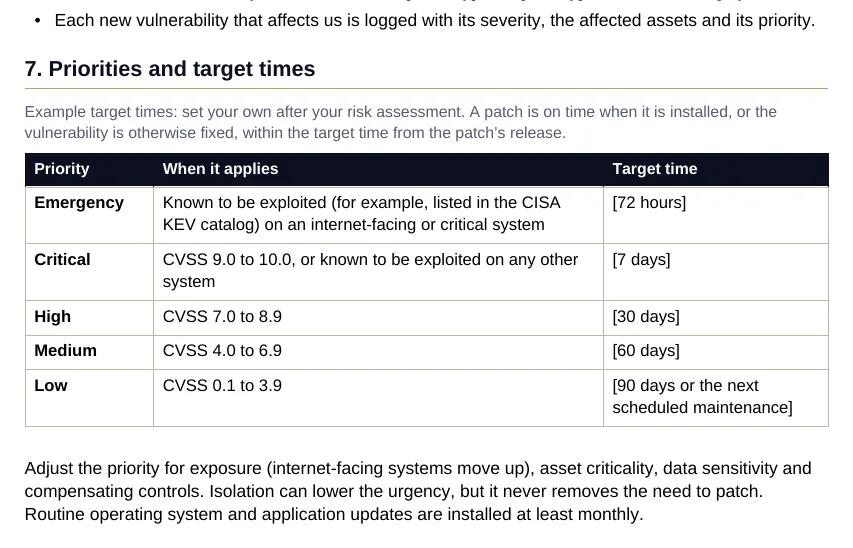
Section 7 ranks patches by known exploitation and CVSS severity, with example target times to replace with your own. Section 13 handles the patches you can’t install in time.
- Emergency priority for vulnerabilities known to be exploited, such as those in CISA’s KEV catalog
- CVSS bands from Critical to Low
- Testing in rings, with a rollback plan for every change
- Exceptions with compensating controls and an expiry date
What it is based on
Built on public guidance
NIST SP 800-40 Rev. 4
NIST’s Guide to Enterprise Patch Management Planning (April 2022) treats patching as preventive maintenance for technology: planned, regular and measured.
CIS Controls v8, Control 7
Continuous vulnerability management, including automated operating system and application patching at least monthly (Safeguards 7.3 and 7.4).
CISA’s KEV catalog
The US Cybersecurity and Infrastructure Security Agency lists vulnerabilities known to be exploited, and recommends that every organisation fixes them first.
Putting it in place
How to roll out the policy
- 01
Know your assets
Build the hardware and software inventory first: you can’t patch what you don’t know you have.
- 02
Agree target times
Set the priorities, target times and exception process with the risk owners.
- 03
Automate
Use tools to deploy and verify patches, in maintenance windows people know about.
- 04
Roll out in rings
Test critical systems, then a pilot group, then everyone, with a rollback plan.
- 05
Measure
Report compliance by priority every month, and review open exceptions.
Avoid the common mistakes
Where patching breaks down
Unknown assets
Devices and software missing from the inventory are never patched.
Everything is urgent
Without priorities, critical fixes wait behind routine updates.
Exceptions that never end
An exception needs compensating controls and an expiry date.
Isolated networks left behind
Air-gapped networks fall behind when there is no safe way to bring patches in.
No verification
A patch that was sent is not a patch that was installed. Rescan to confirm.
Software past end of support
Software with no more security updates needs replacing or isolating.
Next steps
Patch the networks the internet can’t reach
Sources
Sources
Checked on 15 November 2026.
Book a demo
See Tahseen patch an isolated network
We walk your team through an offline import, an approval, a phased rollout with a rollback and the compliance report, in English or Arabic.
- A live demo, not slides
- Mapped to your networks and sites
- Under NDA if you need one
4.9/5 average rating · 98% client satisfaction · 150+ clients served
FAQ
Patch management, answered
What is a patch management policy?
A document that sets how an organisation finds, prioritises, tests, installs and verifies software and firmware updates, who is responsible, the target times and how exceptions are handled.
How quickly should critical patches be installed?
It depends on your risk assessment. Many organisations set days for known-exploited and critical vulnerabilities and weeks for lower ones. The template gives example times to replace with your own, and CIS Controls v8 calls for routine operating system and application patching at least monthly.
What is the CISA KEV catalog?
A list of vulnerabilities that the US Cybersecurity and Infrastructure Security Agency knows are being exploited. CISA recommends that every organisation prioritise fixing them.
How do you patch an air-gapped network?
Download patches on a connected system, check the vendor’s signature or published hash, scan them, and move them in on approved media or through a one-way transfer, under change control, into a local repository.
Can I use it for ISO 27001 or the UAE Information Assurance Regulation?
Yes, as a starting point. Section 3 lists them as references: map each section to the controls you follow, such as ISO/IEC 27001 Annex A control 8.8, and keep the mapping with the policy.
Is the template free?
Yes. Download it, change it and use it in your organisation, with no sign-up.
What does Tahseen do?
Tahseen brings OS patches, antivirus signatures and third-party updates into air-gapped networks through a one-way, verified path. Every package is signature-checked, scanned and approved by a second person, and rolled out in phases.